Showing posts with label math. Show all posts

Wednesday, June 10, 2015

A Voice From Gallipoli: Part II

The most memorable account I can think of about the BMH Hospital in Alexandria, Egypt, is Roald’s Dahl’s in Going Solo. Dahl is best known for having written Charlie and the Chocolate Factory, but long before Charlie, Roald Dahl was a pilot in the RAF during World War Two (he was also a secret agent, afterwards, but this doesn’t matter at the present); he crashed his Gloster Gladiator in the desert and his face was reconstructed in Alexandria. I’m going to guess that very little had changed since 1915, when allied soldiers were being sent there from Gallipoli.
Yale Commencement program,1911
Alexandria was founded by Alexander the Great (no big surprises, there) and is probably best known for its extensive Library. But the Library wasn’t just a library; it wasn’t like your local stopping place for the latest Harry Potter movie…no, this library had all the ancient texts of literature, science, medicine…and was, in fact, only one piece of the Musaeum, a great institution of learning dedicated to the Muses of Greek mythology (‘museum’, anyone?). The Musaeum was like a University long before there were Universities; all the greats came to study there. The place hosted (among others) Euclid, father of geometry, Archimedes, father of engineering, Herophilus, the founder of the scientific method…but most importantly for our purposes, Erasistratus, the man who, in the 3rd century, founded the Academy of Medicine, one of the oldest medical schools ever reordered.
Archimedes' 'eureka!' moment, when he discovered how
to determine the volume of an irregularly shaped object.
eg: a crown
He once said that if he had a lever long enough,
he could move the World.
Galen, one of the very greatest medical researchers of all time, studied there, but unfortunately, the fire that destroyed the Library, also destroyed the medical school. Time wiped away the Musaeum, yet the learning and knowledge that went on there were not completely lost; today our understanding of the world- of physics, engineering, chemistry, mathematics and medicine- is firmly built upon the stones these thinkers carved out of the rock.
The Tower of Hercules in Spain is an ancient Roman lighthouse
built along the same lines as the Pharos of Alexandria
Alexandria is such a strategic locations with its two big harbors, it’s hardly surprising that it played an important role in both World Wars. It served as a British command center, and for thousands of injured soldiers, it was an oasis in the desert, a place where they returned from the front line, little knowing that the methods used to treat their injuries were based on the hard won knowledge of thinkers who had stood on the same ground a thousand years before.
It was from Alexandria that the second letter from Martin was sent. I wonder if he knew the history of the place. Of the Pharos, the giant lighthouse that had once lighted the way of a thousand ships. And of the Musaeum, which shaped the world that came after.
I will stop talking now and let you read Martin’s letter. Please bear in mind that he describes some injuries, so if you are squeamish, proceed with caution. Like the last, original spelling and punctuation have been preserved.
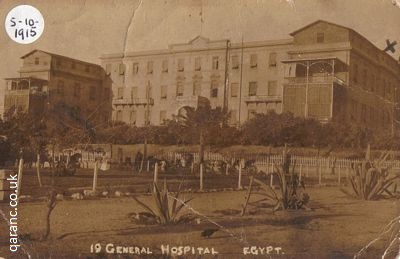
No 19 General Hospital
Alexandria
31st Aug
Dear (great-grandmother’s name),
I wonder if you ever got my little note written from the hills.
Well if you did this is the sequel. I have been one of the lucky ones and still am to be writing this note, but they got me alright. No I in the left thigh and No 2 a little later on, broke my left arm.
Then I went down.
This was on the 10th and I am down splendidly. Blood poisoning all gone, & beginning to sit up and take a little nourishment. 
I hope to be able to go home in about a fortnight. And shan't I just be glad to see the old place again.
A year's soldiering is pretty strenuous!
But fellows are really fighting splendidly, especially the Australians & New Zealanders.
Some of the positions are like going up the side of a house, and directly one shows an eyelid you get shrapnel, machine gun and rifle fire simply poured at you. If I come through this show and I ever see a man shooting a rabbit again, I'll kill him. I could tell you quite a lot of interesting things but the censor forbids. The Turkish snipers are the very devil, I caught one up a tree in a sort of green cage. His face was painted green and his rifle and clothes. Truly a hoary old villain, and stacks of a-mution. Their fellows pick off a lot of our men, they are very daring and cleverly conceal themselves.
Egyptian stamp, 1914
You will see form the lists, that my regiment had a bad time, 23 out of 26 officers gone. It's awful to lose you pals like this, & I am afraid in my present state I get awfully depressed.
But we didn't half make some ground! The Turk (?) on the whole is quite a gentleman in his fighting. His German master has taught him some of them some of his dirty tricks.
A captain pal of mine who was hit close to where I was laying wounded, was hit in the thigh by either an expanding or explosive bullet.
It simply blew the whole of his thigh out. He died in about half an hour of loss of blood, and I couldn't move to help him. A corporal in my own lo(?) was hit in the stomach by a similar bullet, with the same result. There are tact's that happened to come under my notice. We ought to do the same, but somehow we simply don't!
I know you are with us in spirit, so you will be glad to know we shall be through the narrows soon. It's costly but it's going to be done.
I am going to stop now I am getting tired. I hope you can read my scrawl, but writing is not quite so easy as usual just now. Kind thoughts to you and regards to family.
Yours very sincerely,
Martin

I apologize profusely for my absence all this time. I have not been at all well these past six months; sometimes it is a struggle to even get up in the morning, and trying to write a blog post with my foggy brain is pretty much impossible. I hope you will continue to stick with me, anyway.
~Psyche


Friday, March 14, 2014

The Virtues of Pie

Ladies and gentlemen, I present that marvel of ingenuity, the all American hero, the…pie. You are nuts, you say. Well said, for one of the many brilliant designs of the pie is pecan. Seriously though, the pie plays an important role in our nation. This wonderful confection can serve as an allegory of our culture.
Like our country, the pie has a multitude of flavors. From symbolic apple to savory pork and decadent maple to delicate meringue, the rainbow of flavors spreads across a wide spectrum.
The ethnicity spectrum of the pie is just as wide as its flavors. Every culture that comes to our shores has its own versions of the pie.
Our culture has many ingredients combined within the uniting crust of Americanism to form an effective whole. To survive, the ingredients of both pie and America must work together. Who ever heard of a pie that was a household name, which was not delicious? The people of America must also work together if the country is to survive.
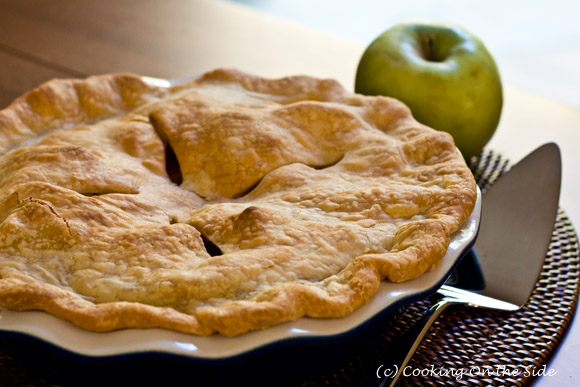
Apple Pie from cookingontheside.com
Now, before we go any further, we may want to define pie. Originally, pie crusts were something called a ‘cofyn’, which was a long narrow crust.
Pies are now pastries that are usually baked in a round pan. This includes a crust placed in the bottom of the pan and often after the pie is filled, a second crust is added to the top. Most pies are baked, but there are a few modern pies, such as ice cream pie, that were born with the advent of the refrigerator.
There are berry pies and custard pies, apple pies with and without cheese, pumpkin custard and pecan
custard and sometimes a mix of the two. There are meat pies and pizza pies. Anything that can be put in a crust becomes a pie.
Pie is a symbol of the American home and a major part of early Americana. It migrated with the early settlers. Not only were they appreciated for their goodness, pies take only a small amount of flour, a valuable resource.
In America pie experienced a decline in the 1870s, because new nutrition experts decided that the dough in pies was weighing down the American spirit. The new jobs available to women cut down on the time in the kitchen and made pie making occasional rather than weekly.
Despite the decline pie remained a fixture on farms and a symbol of the American home. It was not nationally revived for eating until the 1980s in the rediscovering of American cooking.
Key Lime Pie 
In the beginning… Pumpkin pie. Fresh from the oven, spiced creamy golden-orange custard poured into a single piecrust, served with ice cream or whipped cream. This beloved pie has become a traditional part of American holiday celebrations such as Thanksgiving and Christmas.
Pumpkin pie started in an interesting way. The early settlers cut off the top of a pumpkin and scooped the seeds out. They would then fill the shell with sugar, spices and milk. The whole pumpkin would be baked in the fire. Early colonists actually used pumpkin flesh for piecrust instead of using it for pie filling.
In the words of John Greenleaf Whittier from his poem “Pumpkin”:
From North and from South comes the pilgrim and guest;
When the gray-haired New Englander sees round his board
The old broken links of affection restored;
When the care-wearied man seeks his mother once more,
And the worn matron smiles where the girl smiled before;
What moistens the lip and what brightens the eye,
What calls back the past, like the rich Pumpkin pie?

Pumpkin Pie from skinnytaste.com
Apple pie is a two-crust pie containing cinnamon and nutmeg spiced apples. In America, apple pie became a synonym for being American. As the phrase ‘American as apple pie’ shows, apple pie is a symbol of America.
The Apple tree is worthy of the pie. The beauty of the pie is matched by the beauty of the tree all year round. In the spring the tree explodes into a ball of beautiful blossoms. During the summer, the leaves are a lovely dark green. With the fall comes the delicious fruit. In the winter, striped its leaves, the graceful branches can be seen.
Although apple pie is considered a truly all American dish, it was actually adopted. Apple trees came from Asia Minor and immigrated to our shores via England. They then migrated farther and farther west with the help of Johnny Appleseed, a popular American myth known for giving apple trees to people.
Eugene Field expressed his appreciation of apple pie in his poem, “Apple Pie and Cheese”:
…No flippant, sugared notion
Shall my appetite appease,
Or bate my soul’s devotion
To apple-pie and cheese!...
…No matter what conditions
Dyspeptic come to feaze,
The best of all physicians
Is apple-pie and cheese!...
…But I, when I undress me
Each night, upon my knees
Will ask the Lord to bless me
With apple-pie and cheese!

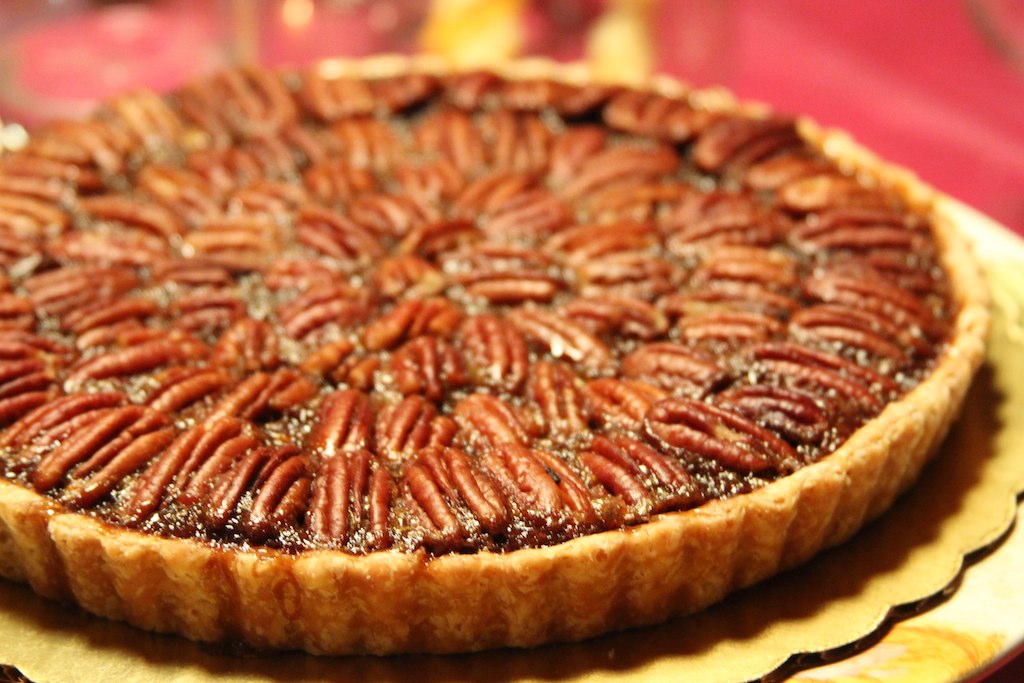
Pecan Pie from Wikimedia Commons
Pecan pie, in the form that we know today, emerged with the popularization of Karo Corn Syrup. Pecans in transparent custard with a high sugar content baked in a single piecrust.
The pecan pie has its roots deep in the American South. According to tradition the pie itself is a concoction from the French colony at New Orleans. I’ve wondered if there was a relationship to praline.
The pecan tree is related to the hickory tree family and is native to the Mississippi valley. It is one of the few important plants native to the United States.
Shoo-fly pie, sticky, gooey cake pie, straight from the Pennsylvania Dutch. A cake made in a piecrust, the bottom soaking with molasses and the top sprinkled with a crumb topping. There are two variations: dry bottom, suitable for coffee dunking and wet bottom, with extra molasses.
No one really knows from where Shoo-fly pie or the strange name actually comes. It resembles an old English dish known as treacle tart, but has been claimed by many nationalities. Shoofly pie is now undeniably American.
Not only is custard pie delicious, it has a great deal to do with slapstick comedy. It seems that a lot of slapstick is not complete without someone getting a pie in his face. One short movie, Battle of the Century, used three thousand pies in filming. Other kinds of pies have been used for this purpose, but custard pie seems to be favored, probably because it is now common to use only meringue, which is softer to receive in the face.
Not all pies are sweet. Some, such as the pizza pie, a flat bread crust with various toppings are meant for a main dish instead of dessert. Pizza is a very good example of a pie that has been made American.
Pizza, which immigrated to the United States from Italy, has become one of the most popular dinners in America. Pizzerias seem to be in every town in America and more than one of America’s major fast food chains specialize in serving pizza.
The roots of our country are in the world. We took ideas and principles from every culture and made them uniquely ours. In the same vein, American pie has its ancestors in every corner of the world.
In the end, everybody wants a slice of…the pie.

~ Rose

PS: Since today is Pi Day, I thought I'd do something appropriate to the occasion. ;)

Friday, March 7, 2014

Icy Physics

Don't get me wrong. I can't skate. The last time I tried I was ten years old and I landed very hard on my head and never went back again. Coward? Maybe.

However, I've had some experience with downhill skiing and after watching this video from Smarter Every Day, I was struck by how many similarity skating and skiing share.

We use hockey stops all the time, and when going down the hill, we ski on our edges. It's not a particularly stable position, but the faster we go, the more stability we have (provided we're in control of our speed). In order to slow down, we ski 'up' the hill, which reminds me just a bit of 'tacking' in sailing. 'Course, I'm not anything like an Olympic skier (I tend to lose my balance if I become airborne) but I can get from point A to point B without falling down.

Just as Destin mentions in the video, we use mathematics all the time. It might be your worst subject in school, but your brain uses it 24 hours a day. Even when you're sleeping, your brain regulates how many times you breathe and your heat beats in a minute to keep you from suffocating. Something as simple as picking up an egg requires a host of mathematical equations. For years, scientists have been attempting to program robots to pick up eggs, but they never seem to be able to achieve just the right pressure to avoid smashing the egg. Even a dog can carry an egg in its mouth without puncturing it.

The human brain is an amazing thing. Not long ago, I was talking to a brain surgeon (no, there's nothing wrong with my brain) and he was describing a certain rare condition called an arachnoid cyst. Arachnoid cysts can form in your brain at birth and are generally harmless, but they range from the size of a quarter to filling one half of your skull. Despite the tiny brain sufferers are left with, there are hardly any symptoms and generally no impact on intelligence. Blows my mind (no pun intended); after all, the human brain is the only brain that is capable of studying itself.

Now I will shut up and let you watch the video (if you haven't already seen it); make sure you watch all the way to the end. I think Reepicheep is adorable with ice skates on (If it doesn't work, you can find it here).

~Psyche