Thursday, February 27, 2014

Amazon Breakthrough Novel Award

I just entered the Amazon Breakthrough Novel Award contest.

I've been thinking about doing it since last year, and now I've finally done it...me and 9,999 other people. Now I'm wondering why I even bothered. That's 10,000 of us, which means I have a 1/10,000 chance of winning...I might as well pull the sheets off my bed and try parachuting out my window. I'd probably have an equal chance of success.

But, after all, what can I lose? It's free and the rewords are very exciting for the person who happens to squeak through and win.

There's still time to enter, if you're interested. The contest closes March 2, or whenever the 10,000th eligible entry is accepted (which could be any second).

If you want to enter, you will need:


  1. A CreateSpace account.
  2. An original, fictional novel manuscript between 50,000 words and 125,000 words
  3. The first 3,000-5,000 words of that manuscript
  4. The complete rights to that manuscript (it could be self published, but you cannot have signed a contract with a publisher).
  5. A pitch (which is basically 300 words marketing your story to the judges)
Happy writing...or not; maybe you're not all as crazy as I am. ;)

~Psyche

PS: I wrote a limerick...yeah, I know it's bad, but everyone was writing one on the contest forum. Here goes:

I came across an Amazon contest
(You can probably guess the rest)
My sanity I forsook
And entered my book
And now I'm expiring from stress.

Tuesday, February 18, 2014

14 Unusual Animals

There are more than one million non-insect species on the face of the earth and new ones are being discovered every day. The biggest creature is the Blue Whale with a heart the size of a small car and the smallest is the Pigmy Shrew that can apparently die of a massive heart attack if touched. In between, are a host of creatures, both great and small. Every animal is extraordinary, but Rose and I have complied a list of some of the most unusual (none of the images below belong to us; all rights to the very talented people who captured them ).

1. Jerboa
Image of a Northern three-toed Jerboa, courtesy of Montarano Nature Photography


When I first saw footage of this, when I was very small, I was under the impression that it was a sort of miniature Kangaroo. Now I think it looks a bit more like a long tailed Rabbit. Jerboas live in deserts anywhere from Northern Africa to Northern China and everywhere in between. Despite their small stature, they can reach speeds of up to fifteen miles per hour.

2. Chinese Water Deer


This is where Bambi meets the Saber-toothed Tiger... and Water Deer are not the only deer with fangs, other small species, such as the Tufted Deer and Muntjac, have fangs as well. Because the fangs are held loosely in place, they can be drawn out of the way when eating, but when danger threatens, they present a frightening site. Water Deer lack antlers...but I have a feeling they don't need them.

3. Clouded Leopard

This shy, Himalayan cat is more beautiful than strange, but its coat is remarkably unusual. Speaking of teeth, the Clouded Leopard has the longest canines in relation to their body size of any living carnivore, even though they are the smallest of the big cats. They aren't related to Leopards. 

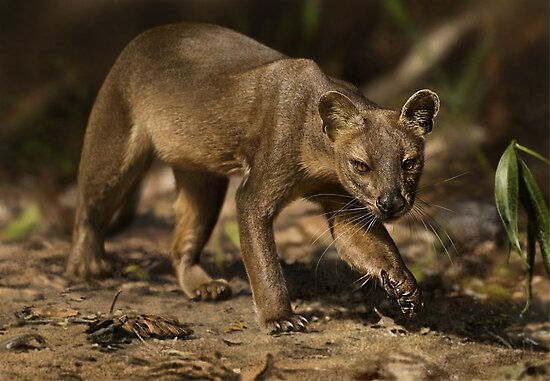
4. Fossa


Not a cat, nor even a dog, the Fossa is its own species, existing only on Madagascar. It looks like a small Puma and even has retractable claws, but its head is more like a mongoose's. They are fairly rare, mostly solitary and cathemeral; which means they are sporadically active day and night.

5. Aye-Aye


The Aye-Aye perpetually looks as though it has had a very bad fright. Like the Fossa, it exists only in Madagascar and is known for the unusually long fingers that it uses for prying bugs out of holes in tree trunks. It's a kind of Lemur, which means it's a primate. 

6. Elephant Shrew

Rose thinks this is a cross between Piglet and Dumbo...in fact it has no relation to either. All Shrews have unusual noses, but the Elephant Shrew is particularly unusual. They use their strange proboscides to find food, then flick it into their mouths with their long tongues. There are several versions of the Elephant Shrew, all native to Africa. 

7. African Civet


No, it's not a Raccoon, but it's the best known of its species, which isn't very well known. It bears a resemblance to a hyena, but its actually of the family Viverridae. Civets are named because of the musk they produce, which is often used as a perfume base...weird, right?

8. Saiga Antelope


He looks fine until you get to his nose. The Saiga Antelope once lived in the vast Eurasian Steppe, from Hungary to Siberia and was even found across the pond in North America. Today, there are very few of them left in a handful of places in Kalmykia, Kazakhstan and Mongolia. 

9. Proboscis Monkey


Speaking of noses, this is a nose...maybe we have a theme, here. The Proboscis Monkey is one of the largest monkey species in Asia. They are pot-bellied and often times their toes are webbed. They live almost exclusively off leaves and fruit. 

10. Emperor Tamarin


Named because of his striking resemblance to Kasar Wilhelm II, he and his mustache, live in the Amazon Basin. The Emperor Tamarin is affectionate and friendly and lives in large family groups. Does he look like something that could wage the First World War?...I don't think so, either.

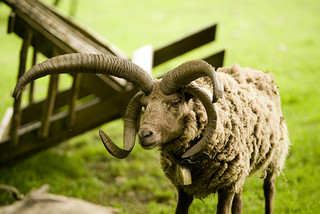
11. Manx Loaghtan


This odd sheep looks like he couldn't decide on a set and ended up settling for both. Originating on the Isle of Man, the Manx Loaghtan can come equipped with up to six horns. Even though it is a rare breed, it is considered a gourmet delicacy and is known for its soft, brown wool.

12. Maned Wolf


Something like a fox on stilts, the Maned Wolf is native to South America. It isn't a wolf at all... nor is it a fox. Like the wolf and the fox, it belongs to the family Caninae, but has its own Genus. Because of its strong odor, it's sometimes referred to as the 'Skunk Wolf'.

13. Duck-billed Platypus


You've all heard of this one, I've no doubt, but I still think its fascinating. It's a Monotreme, one of only a handful of beaked mammals that lay eggs. They're all from Australia, or New Guinea, and sometimes their babies are called puggles. Despite the fact that their young are hatched, they are still true mammals, being warm blooded and producing milk.   

14. Okapi


Finally, the best (and probably the rarest) for last. The Okapi is likely what you'd get if it were possible to cross a Giraffe with a Zebra. A small number of them live in central Africa and in zoos around the world. They are so rare, it wasn't until 1901 that the species was formally recognized, but the Egyptians knew about them thousands of years ago.

Monday, February 10, 2014

14 Most Adorable Animals

I've always been an animal enthusiast and I used to amuse myself by watching countless hours of nature movies and reading vast tomes on various fauna from around the world. Rose and I have complied a list of fourteen animals we think are the cutest and most heart-melting (and if they don't melt your heart, you must have a heart like a rock).

1. Fennec Fox

These little creatures, belonging to the genus Vulpus, are indigenous to North Africa, but aren't uncommonly found in homes around the world. They make energetic house-guests, but can be trained to some extent and apparently have a weakness for strawberries (I don't have a source for the last one).

2. Red Panda


Not closely related to Pandas at all, Red Pandas have been classified as anything from Raccoons to Bears. Nowadays it's thought they are more closely related to Weasels. They are shy creatures and mostly nocturnal as they roam the forests in the foothills of the Himalayas.

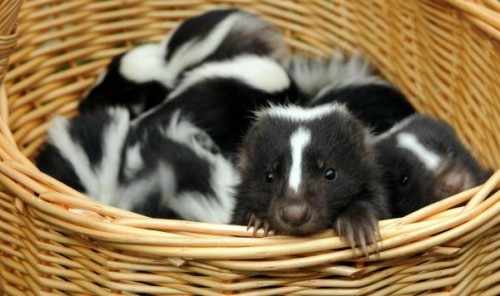
3. Skunk


Skunks may not be your first choice as cutest animals, but once you get past the smell, we think they definitely rank (no pun intended). They apparently love honey and their thick fur guards them from getting stung when they're stealing some.

4. Kiwi


We're still not sure whether the bird is named after the fruit or the fruit is named after the bird. We love them both (in different ways). Kiwis, of course, are indigenous to New Zealand, but we're not sure if there are any specimens in Middle Earth.

5. Squirrel Monkey

These are New World Monkeys, meaning they can be found in Central and South America. When they're not hanging around in the jungle, they are often kept as pets. However, they are very mischievous and demand a lot of care.

6. Chinchilla

The last time you might have seen a Chinchilla might have been in a fur coat. During the Victorian age, they were renowned for their remarkably dense and soft fur. I've felt it before, it's like a gray cloud. They live in the Andes and apparently maintain their fur by rolling in the superfine dust of volcanic pumice.

7. Rock Wallaby


Wallabies are smaller relatives of the Kangaroo. Rock Wallabies live where their name suggests; in rocks and caves. They're agile and quick, often with colorful coats, but you probably won't get to see one, because they are nocturnal. Which, considering the hot and arid climate of  their habitats in Australia, is probably a good thing (for them, anyway).

8. European Robin


As I was growing up, the only kind of Robin I knew was the American version, which, apparently, isn't a Robin at all. Our version is from the thrush family, while the European Robin is considerably smaller and rounder and more closely related to flycatchers.

9. European Red Squirrel


Speaking of Europe, apparently their squirrels are different from ours, too. Over here, we seem to be overrun with gray squirrels that can grow to be the size of small house cats. Red Squirrels are fewer and farther between and over in Europe, Red Squirrels come with an accent. Ear tufts. Makes me want to get a pair myself.

10. Pygmy Hippopotamus


The scaled down version of the Hippopotamus never gets more than three feet high at the shoulder, but it can  still manage a whopping 600 lb in rare instances, which is still a far cry from the 4,000 lb of its full sized relation.

11. Pygmy Marmoset


Pygmy and cute just seem to go together. The full sized Marmoset was cute to begin with, but smaller is even better. They live in Amazon rain forests and exist almost exclusively off tree gum...that's resin, you and me.

12. Fruit Bat


Rose thinks all bats are cute; I think some may disagree with her, but the Fruit Bat is unarguably darling. There are only three bat species that drink blood; they exist only in Central and South America. The rest eat fruit and insects and are perfectly harmless.

13. Hedgehog


In this case, spines just add to the effect. I doubt they're very cuddly, but they look like they'd like to be. As the name implies, hedgehogs are frequently found living under hedgerows, or hedges laid and trained from young trees. Hedgehogs will eat pretty much anything they come across, from mushrooms to melons...so you might not want one in your garden.

14. Highland Cattle


Last is not least. Highland cattle are an ancient breed, with long, dense coats to keep out the rain and wind of Highland Scotland. Sometimes, at shows, they become poofy after being washed and brushed and some people refer to them as 'fluffy cows'.

Note: None of the images above belong to us; all rights to the very talented people who captured them.