|
Walking tank?
Tudor or Elizabethan jousting armor
Image by Tirithel |
Once upon a time, there was a knight. This knight carried a great, heavy two-handed sword and wore upon his person a suit of shiny armor. He traveled up and down the country on his gigantic charger righting wrongs and saving damsels that had gotten stuck in towers. Everyone knew who he was because he wore on his helmet a fluffy plume and carried in his right hand a stripy lance...
We'll stop it there.
There are probably several things about this description that we know immediately are wrong. Knights didn't go riding around righting wrongs (unless they happened to be named Don Quixote) and damsels hardly ever got stuck in towers. Stripy lances of course, were only used in jousts, which didn't really get going until the High to Late Middle Ages. But the rest of it is wrong, too, at least in the context of a serious battle (admittedly, I know very little about these things and I will endeavor not to sound like a complete idiot as I continue).
There are
several misconceptions about knights...all largely to be blamed on Sir Walter Scot. As I was growing up, I was under the impression that European knights of the Middle Ages wore plate armor to battle and that this plate armor was so heavy that the only horses that were strong enough to bear the weight were draft horses. Not only that, but when these slow-poke Medieval knights ran into warriors from other cultures, they met instant death, because the weapons, armor and horses of these other cultures were either sharper, lighter or faster.
This actually isn't true.
 |
Joan of Arc, one of the most famous armor
wearers in history, was active in the 15th century,
which was after the start of the Renaissance |
To start out, knights of the Middle Ages didn't wear full plate armor, and didn't wear suits of armor at all, until
the end of the era. Plate armor originated as a sort of 'bullet-proof' vest made of small plates to supplement mail. True plate armor and suits of armor did not come to their own until the period called the Renaissance when it was already rendered obsolete by the advent of firearms. For the most part, full suits of armor were not worn in battle, only for tournaments, or
parades. The stuff isn't as heavy as we probably were led to believe (a full suit doesn't weigh more than sixty pounds and is generally half that weight) but it's still hot and unpleasant and restricted vision. Some of the most famous suits of armor still in existence are parade pieces that belonged to Henry VIII. Fully suited up, it's said Henry had to be hoisted aboard his horse with a crane, but this was more due to the weight of the King than to the weight of the armor. I feel bad for the horse.
So what did they wear?
 |
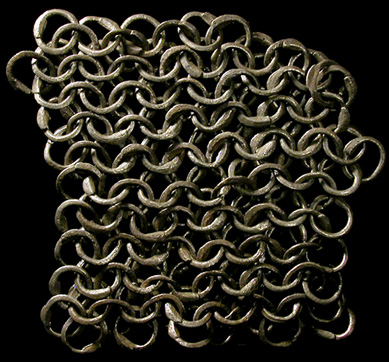
A piece of hand-welded Medieval mail
ancientresource.com |
They wore exactly what everyone else wore; after all,
mail shirts have been around for centuries. The Vikings wore them, the Mongols wore them, the soldiers of the Islamic Golden Age wore them. Mail shirts themselves were excellent protection against both slashing and stabbing cuts and would even limit the penetration of a longbow, or crossbow bolt. They didn't do well against battle axes, or war hammers or a horseman's lance; even so, wearers were more likely to die from concussion than the horrific gaping wounds we see in movies. Because each ring had to be welded or riveted into a
particular pattern by hand, mail shirts were also expensive, so most people just wore
hard leather, like boiled leather or rawhide, which offered fairly good protection.
Which brings us to Helmets.
 |
This nasal helmet was used extensively by he Normans
and shows hints of their Viking ancestry
this is a replica of the style used between 10th-12th century
Image by Silar |
Helmets didn't get visors or plumes on them until
tournaments in the later Middle Ages and early Renaissance . During the Early to High Middle ages, or the era we associate with the Crusades, a
helmet would simply be a metal cap with a nose guard. They were made of steel, and with the knight's own hair bound up under them, they weren't half bad for protection. By the end of the 12th century, flat-topped cylindrical helmets, that looked a bit like tin cans with eye holes, were vogue. A direct blow to either helmet from the era with a broadsword would only dent it, not cleave it in two.
The first line of defense...
Was not the sword at all. The sword was a personal weapon, only to be used in close quarters. The Romans
 |
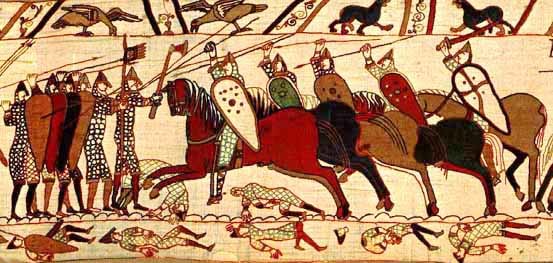
| The Norman charge of the Saxon shield wall at the Battle of Hastings |
used long cavalry swords on the Barbarians and by the 18th century, sabers could be used effectively from horseback because of the reduced armor, but during the Middle Ages, the Knight's first weapon was the
spear, or the lance. Cavalry charges with outstretched spears were frightening things, especially with the weight and momentum of the horses behind them. They could break through shield walls and had no trouble with mail shirts. Jousting on either side of the tilt, or barrier, was a Renaissance invention, inspired by the days when knights
charged each other across open fields with sharpened spears in the Middle Ages, then battled it out on foot. Jousts were not a major part of Medieval tournaments, which originated as free-for-alls with armies of Knights wielding swords and spears: the goal was to capture as many of the opposing Knights as possible and hold them for ransom. Ivanhoe really didn't have it right.
And speaking of broadswords...
 |
A classic Medieval sword, a type VII, this replica
weighs 2lb 10oz. Sword is by Albion Swords, while the
scabbard and the picture are by DBK Custom Swords |
They weren't that heavy, either. And despite their differing profiles and construction, they compared to the weapons of other cultures. For example, they are similar in both the cut and the thrust to a curved blade, despite the radically different shape. They were also quite sharp, but because of the weight and shape of the sword, a 'razor edge' wasn't necessary to be effective. By the Early Middle Ages, the advent of the weighted pommel made the wielding of European swords quick and fluid. In later years, massive two-handed swords nearly six feet long were vogue, but during the Early to High Middle Ages,
a one-handed sword weighed between two and three pounds. To put it in perspective, a 'light' sword of another era, the rapier, often weighed about two and a half pounds. Battles sometimes lasted all day and we can't have our knight getting worn out, now can we?
Now we'll get to the Horse.
At its heaviest, a mail shirt only weighed thirty pounds and most mail shirts weighed between ten and fifteen
 |
The modern Frisian is a medium sized horse, with a usual height
of sixteen hands, that is descended from Medieval war horses |
pounds, and since most mid-sized horses can easily carry three hundred pounds, weight was not a great factor when choosing a horse. Inspection of horseshoes and horse armor from the Middle Ages suggests that Medieval warhorses were between fourteen and sixteen hands, or between 4'6" and 5'3" at the shoulder, only slightly smaller than modern day hunters. Compare that to modern draft horses that can be upwards of six feet at the shoulder...and uncomfortably wide to ride.
 |
Many references were made to Spanish horses during the Middle Ages.
The Andalusian is a very ancient breed and like
the Freisian, they are agile and highly intelligent
Wenni on Flickr |
The biggest factor in a knight's horse was not size, but training. Most knights, or soldiers from the Middle Ages, rode coursers, or light, fast horses that could get them there and back and do it in a hurry. A handful of knights owned
destriers, which could be worth seven times as much as a courser. Destriers were generally more agile and more strongly built than coursers, but most importantly, they had specialized training.
Today, we call it horse dancing, or dressage. In Vienna, the
Spanish Riding School has developed a breed devoted to it, called the Lipizzaner. Medieval desteriers were trained to fight on command. Moves that are natural in the wild, such as bucking, rearing or kicking, were refined into specialized moves that we watch today at the Olympics. A knight's life might depend on the responsiveness or agility of his horse, but also on his steed's ability to land a well-aimed kick. A sword is important, but a horse can be a secret weapon.
In conclusion...
 |
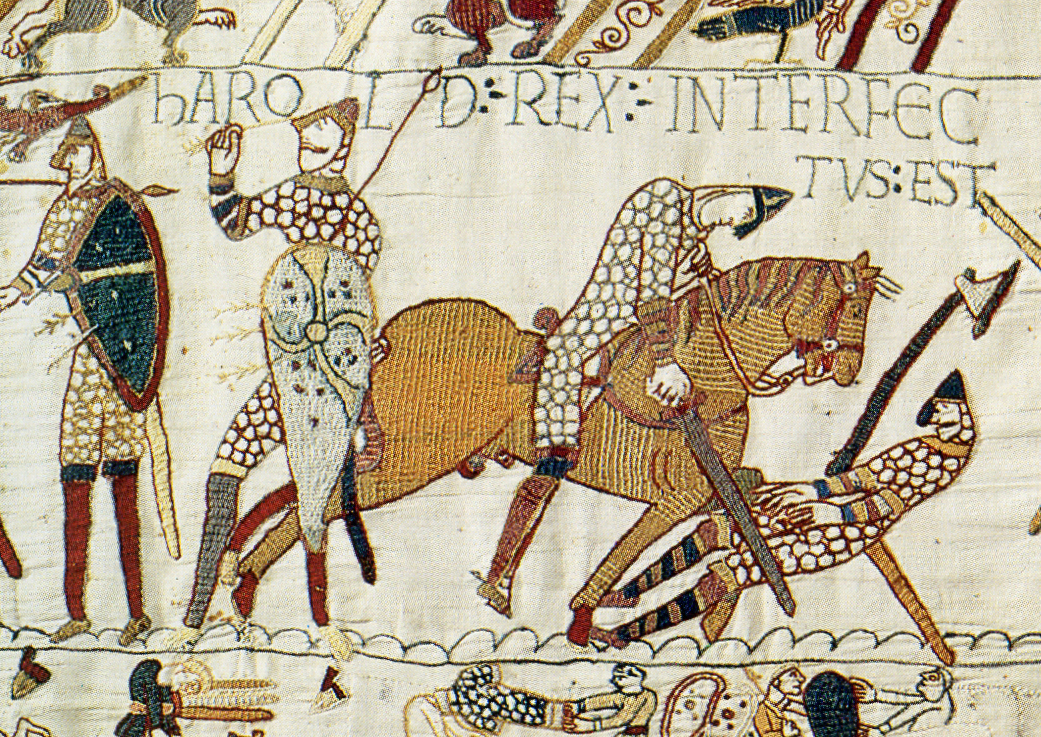
Probably the best depiction we have of Medieval knights is in
the Bayeux Tapestry (which isn't actually a tapestry) |
Medieval European knights were much more frightening than the suit-of-armor stereotype rattling about like a pile of crockery on a falling-asleep draft horse. Instead, they wore flexible mail shirts or tough leather that was nearly impervious to Medieval weapons, wielded spears that could punch through armor while riding about on horses that were capable of spinning in place, kicking you, or leaping into the air on cue.
Of course, the armor, the weapons and the horse might set you back the same amount that a four bedroom house would today, so there weren't very many of these fearsome knights around.
~Psyche