Showing posts with label the Dark Ages. Show all posts

Monday, October 13, 2014

Medieval Architecture

Warwick Castle, by Extra Medium on Flickr
There are more than a thousand relics, ruins and remnants of the great stone castles that once dominated England. It’s easy to think, after seeing pictures of the likes of Warwick Cast, or the Tower of London, that the all the people of Medieval England either lived in gigantic castles, or mud huts which have since disappeared. Neither is really true. There were enough people groups and building styles it’s like to drive you mad, but I will attempt to tell a little of what I’ve found out.

Background

Maiden Castle
The Bronze and Iron Age Celts constructed ring forts (in Ireland) and hill forts all over the British Isles. The distinctive circles can be seen under the turf especially well at Maiden Castle in Dorset, the largest of the Iron Age hill forts. For the most part, these hill forts were small towns, surrounded by concentric rings of earthworks and palisades with very little stonework. In Ireland, on the other hand, the ringforts were built of stone.

The Grianan of Aileach, an Irish ringfort in Ulster,
was rebuilt in the 1870s by a group
of overenthusiastic archaeologists

The great builders of stone, however, were the Romans, who showed up in AD 43 and, over the next four hundred years, completely remodelled the face of Britain. The Romans had a particularly efficient way of laying roads and walls, as was demonstrated by the building of Hadrian’s Wall along the Scottish border in just six years. Distinctive Roman walled cities sprang up in places like London, Chester and York and because of the relatively gentle British climate, the Romans and Romanized Britons were able to build Italian style villas, which were envied by even the aristocrats in Rome. Probably the most famous Roman site in Britain is the city of Bath in Somerset with its partly rebuilt, but still functioning bathhouse.

The Anglo-Saxons

The Greensted Church in Essex is the oldest wooden church
 in the world and is considered by some to be the oldest
wooden structure in Europe. The Anglo-Saxon frame has
been covered over by later additions, but it still remains,
along with curious original elements like leaper holes in the walls.
The Romans left Britain in AD 410 and the Angles and Saxons took their place. For many years, archaeologists declared that since they couldn’t find anything really conclusive, the early Anglo-Saxons had no distinctive building style and never built anything of note. Which, of course, isn’t true.
It now appears that Viking and Norman eradication of everything Saxon, coupled with the Anglo-Saxon habit of building with wood, pretty much wiped out any remnants of Anglo-Saxon architecture. Yet, in some nooks and crannies of England, there are still some bits and pieces that the Normans forgot and the elements haven’t rotted away.
The Exeter City walls show layers of history; Roman on the
bottom, Anglo-Saxon in the middle, Norman on the top
It seems that the Anglo-Saxons took their inspiration from Roman architecture, incorporating columns and arches into their buildings. The Saxons didn’t have the expertise of the Romans, but they made every effort to repair or replace crumbling Roman buildings and walls. Through the Dark Ages, the Anglo-Saxons didn’t build great stone castles, but they did build small wood and stone churches. Their houses were probably very much like our vision of an English cottage of timber and daub and a great thatched roof. Their castles or Burhs (the root of the word and concept ‘borough’), like the Celtic hill forts of old, were made of earth and wood.
The Anglo-Saxon tower on Trinity Church in Colchester

by Nic McPhee on Flickr
Under Alfred, England really became England and for some reason, around that time, the Anglo-Saxons caught the Cathedral fever and started to build big. I'm not sure why they felt the need to build massive cathedrals rather than massive castles; perhaps it was because prosperity abounded and, in a unified kingdom, everyone felt more secure, even though the truce with the Danes was quite shaky. Either way, they probably would have been wise to build castles instead of cathedrals, considering what came over the sea in 1066.

The Normans
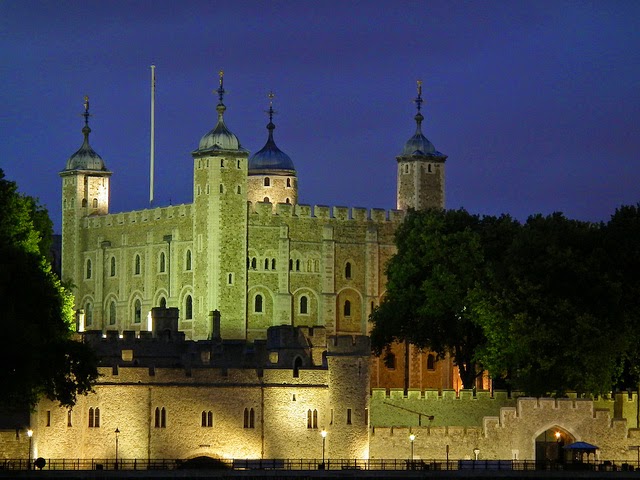
The White Tower, built by William the Conquerer,
was probably the first significant Norman structure in England
The ornamental domes are not original to the building
by Stewart Morris on Flickr
The Normans were master castle builders. They were so prolific, they built them all over the British Isles, all over France, all over Italy and all over the Holy Land. They even imported stone from France to build structures like the Tower of London and remodel Canterbury Cathedral. They were trying to make a statement with their massive, stark designs and used castle building as the chief means of taking over territory. In order to build a castle, a noble had to ask the King specially, and even then, the noble was limited to the number and style. Only the Marcher Earls of the boarder and interior of Wales and Ireland could build castles as they chose. Even now, Wales has more castles per square mile than anywhere else in the world.   
The Jew's House by David on Flickr
But the Normans weren’t all about castles. After they leveled the Anglo-Saxons, took out the Danes and made inroads into Wales, Ireland and Scotland, they remodeled or rebuilt all of the Saxon Cathedrals and added some of their own. They built great new monasteries on Saxon foundations and added new layers of stone over Saxon repairs of Roman walls.  But I think the most fascinating and intimate structures are the few remaining examples of Norman houses.
Saltford Manor House
Probably the oldest remaining town house in England is the Jew’s House in Lincoln. It was built sometime in the mid-1100s and it looks like a very tiny Norman castle with four walls and windows. On the same street is the aptly named Norman House, which is dated between 1170 and 1180 and probably also belonged to a Jew before the Jews were expelled from England.
An even older example of Norman architecture is the Saltford Manor House in Somerset, which is considered to be the oldest continually occupied private house in England. It was built before 1150 by William Fitz Robert, 2nd Earl of Gloucester for the Bishop of Coutances.

Afterwards

Bodiam Castle in East Sussex, is much smaller than it appears
by Brian Snelson on Flickr
Norman Architecture spanned the 11th and 12th centuries. By the High and Late Middle Ages, castles were becoming less menacing and more showy; Bodiam Castle, for example was built to look grander than it really was and Henry III build a beautiful Palace in the middle of the stoic Windsor Castle.

People were starting to become interested in windows and Motehouses like Markenfield Hall and Ightham Mote were built with the aim of balancing comfort and defense. After a while, defense was forgotten, the Middle Ages were left behind and the Tudor period began. 
~Psyche

Monday, August 11, 2014

How the Middle Ages Weren't Backwards

Construction on Pisa Cathedral was started in the 11th century
the bell tower was begun in the 12th; it started leaning almost at once
It’s hard to say when the Dark Ages ended and the Middle Ages began. Some people even argue that the Dark Ages and the Middle Ages were the same thing. After all, they were both Dark weren’t they? Of course, if the Middle Ages and the Dark Ages were the same thing, then part of the Renaissance occurred in the Dark Ages...
Probably one of the biggest misconceptions about the Middle Ages is that people never washed. They might have a bath once a year at the most…oh, and they believed the earth was flat.
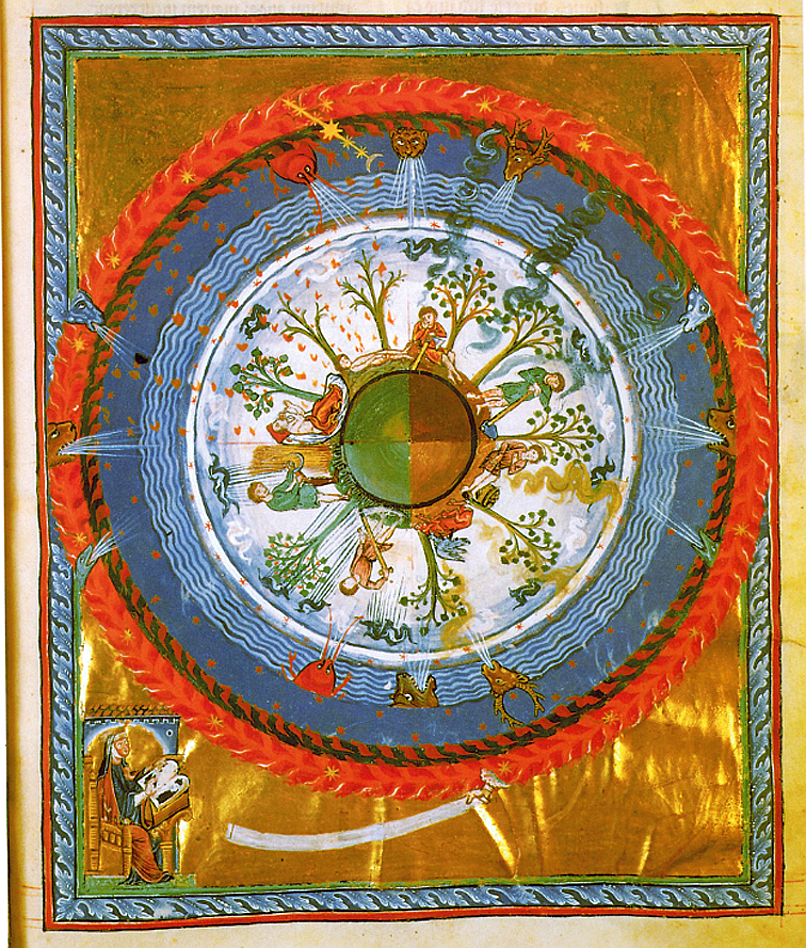
Medieval illustration of a spherical earth from
the 12th century book, Liber Divinorum Operum 
by Hildegard of Bingen

In fact, bath houses were a common sight in the Middle Ages. The Romans had put them in and really, they never went out of fashion. There are even records of people taking baths once a week. It was considered good manners to wash your hands before and after dinner (and you couldn’t rest your elbows on the table). There was even communal bathing where lords and ladies ate their dinner while sitting in a bath…somehow, I’d rather not revive that fashion.
And as for the earth being flat…well, that went out of fashion during the Greeks and it was never seriously considered since. There are Medieval depictions of a round earth and most scholars even had a general idea how far it was in circumference. The only reason we were told they thought it was flat, was because Washington Irving took some liberties in a history of Christopher Columbus.
Roadside picnic? Possibly 12th century
As far as I can tell, the Middle Ages weren't dark and dreary. There was a host of musical instruments, many the precursors to instruments we are familiar with today. Not all songs were written for the Church, like Sumer Is Icumen In which is about summer time. The modern depictions of peasants wearing un-hemmed gunny sacks (who wouldn't hem their gunny sack?!) don't match any of the illuminations from the time. Bright colors were in during the Middle Ages and though the common peasants probably couldn't afford the rich dye the nobles could, many less brilliant colors can be produced with moss, berries or other homegrown plants. Modern forensic evidence also reveals that cathedrals would have been a brilliant riot of colors inside and out...no drab gray stone, there.   
13th century ivory statue of Mary
and Jesus, made in France
Women weren't repressed during the Middle Ages, either. It’s true that they were used as political footballs, but so were the men. There are several accounts of powerful ladies kidnapping perspective husbands and forcing them into marriage. Robert the Bruce’s mother found this method particularly Useful. Women had trades and ambitions just like men. Abbess Hildegard of Bingen was a polymath who wrote a book on medicine and was so respected that Popes and Kings asked for her advice (a polymath is a genius in multiple areas; Leonardo Da Vinci was one). A woman even wrote the first autobiography in the English language. Her name was Margery Kempe.

This interesting Medieval painting
shows a woman riding astride in a skirt
clearly doing some damage with a sword
There were advancements in Science, as well. A friar named Roger Bacon shined light through a sphere of water and discovered that white light is made up of colours. Sorry Isaac Newton. Inspired by the story of Daedalus, A monk named Eilmer of Malmesbury made an attempt at gliding flight in the 11th century. He soared a little ways before he fell and broke his legs. He was forbidden from trying again even though he’d figured out that he’d need a tail to stabilize himself.
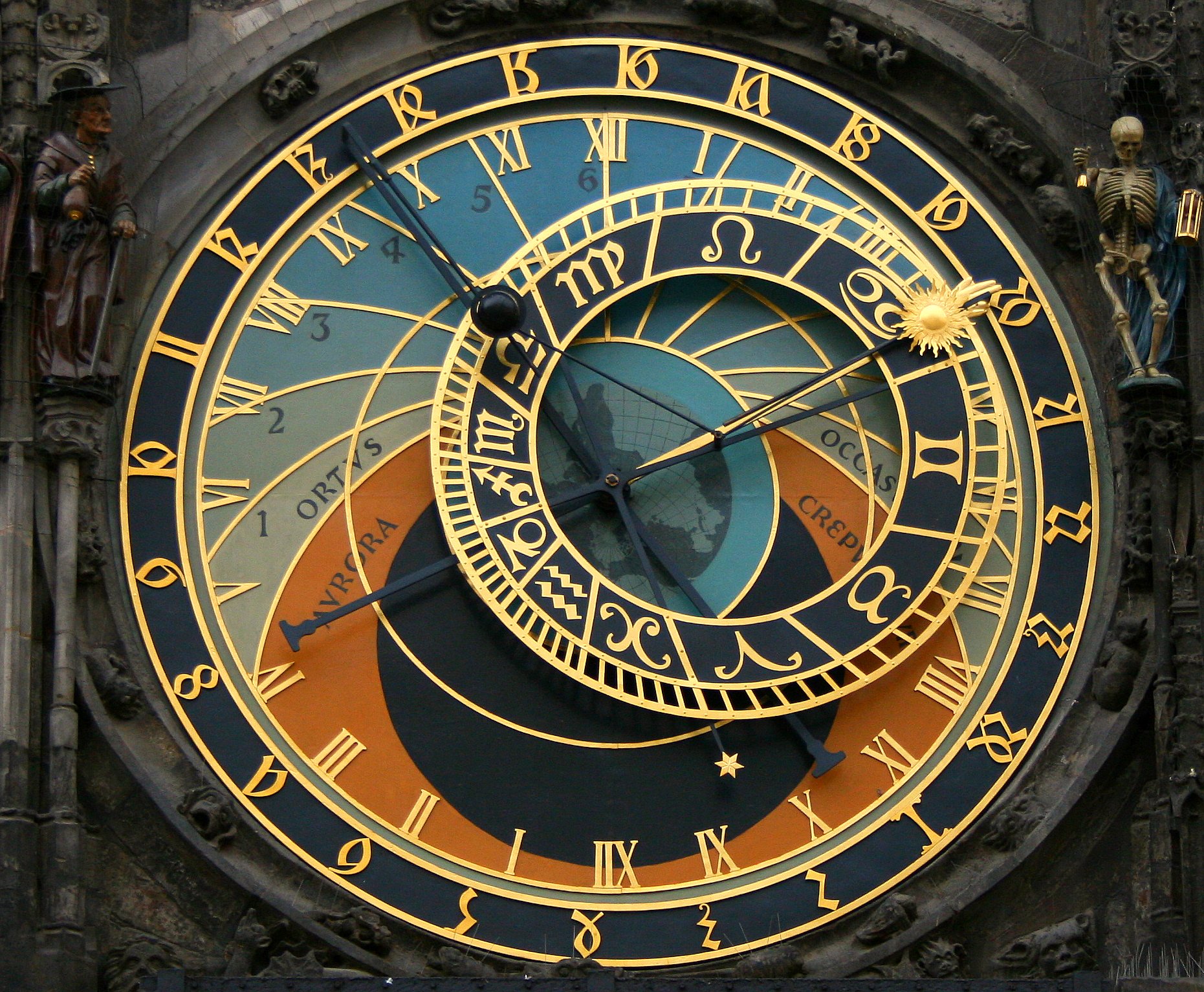
There are accounts of sailors using compasses as early as the beginning of 13th century (through the Vikings probably had compasses when they sailed to the New World in the Dark Ages) and glass reading stones used for magnifying text. An abbot named Richard of Wallingford made an astronomical clock in the 14th century. Before that, everyone used water clocks; they were useful for telling time…and putting out occasional fires.
Installed in 1410, the Prague Astronomical Clock
 is the oldest working Astronomical Clock in the world

Hours of Jeanne d'Evreux c. 1325-1328
Even Medieval medicine was surprisingly complex. They knew how to tie off arteries and insert drains in wounds and even had a rudimentary understanding of herbs and plants that would slow infection. And hospitals weren't uncommon, especially in the 13th century. Of course, the Black Death swept through Europe in the 1300s, but it only arrived after it had finished with Asia. In fact, in the first half of the Middle Ages, people were about the same height as they are today, which means that they had good diets and were generally healthy.
Canterbury Cathedral, an early example of Gothic
 architecture, was built in the 11th century
and figured into Chaucer's Canterbury Tales
The Middle Ages, of course, were the days of feudalism, where lords owned vast tracts of land, while peasants had to rent, and serfs were practically slaves. But, the roots of the middle class lie in Medieval society, only they were called the freeholders in those days. The Yoemen, for example, owned land, not less than one hundred acres, and were sometimes more wealthy than the gentry. The serfs were at the dead bottom and required to work for their lords in return for justice and the ability to work land for themselves…but to tell the truth, serfs were required to work for fewer days in a year than modern full-time employees.
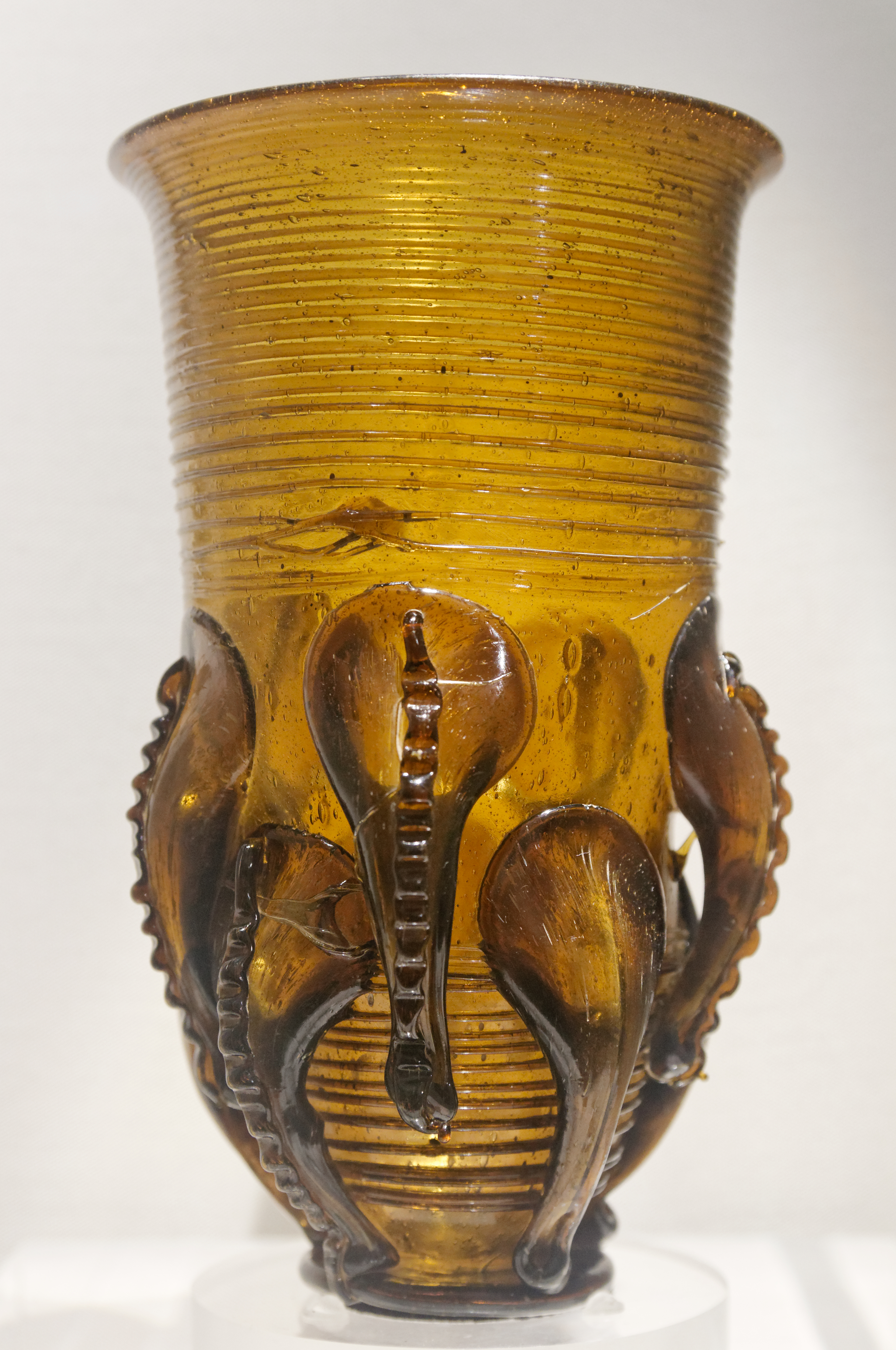
European Beaker from the 13th century
Corning glass museum
Now, did the Catholic Church stifle learning? If you look above, you’ll see that the scientists that I’ve mentioned were all friars, monks or abbots…and they weren’t the only ones. The Catholic Church might have coloured the facts or reinterpreted them to suit it, but it also didn’t keep the Bible to itself, either. Before the advent of the printing press (which was invented in the Middle Ages) Bibles were copied by hand so meticulously that if there was one typo, the whole page was destroyed and started over (I’d better stop what I’m writing right now). Bibles were clearly very rare and expensive, but Henry the VIII still commanded that there be one chained in building of his new Anglican Church (after he'd demolished a lot of them, but that's another story).
The exquisite Gloster Candlestick
made in England c. 1104 -1113 
To put it in a nutshell, the Renaissance never happened for the simple reason that it didn’t need to happen. The Middle Ages were doing very well on their own. They didn’t need a rebirth; enlightenment had been around for years. Yes, there was  flowering of the arts and science, but the flower could only bloom because the stem had been growing steadily all through the Dark Ages.
Advancement was slower than in earlier and later years, but when a gigantic empire collapses and no less than three powers attempt to take over the world (not to mention a plague that wiped out a third of the population) advancement gets put on the back burner. Learning was a small flame that continued to burn, it only needed economic stability to blow it into a bonfire. 
~Psyche 

Thursday, July 17, 2014

How the Dark Ages Weren't Dark

A replica of the Sutton Hoo Helmet
We’ve all been taught about the Dark Ages and how a shroud of ignorance and superstition was cast over the western world by the fall of the Roman Empire. We even know how, after the Dark Ages were over, Europe slowly struggled into the Middle Ages; a dark, strict and unpleasant time, dominated by a Church that religiously kept the Bible away from starving peasants. In fact, we might even recall how, after much learning finally filtered over from the Far East, Europe managed to claw itself into the Renaissance, a rebirth of enlightenment and learning.
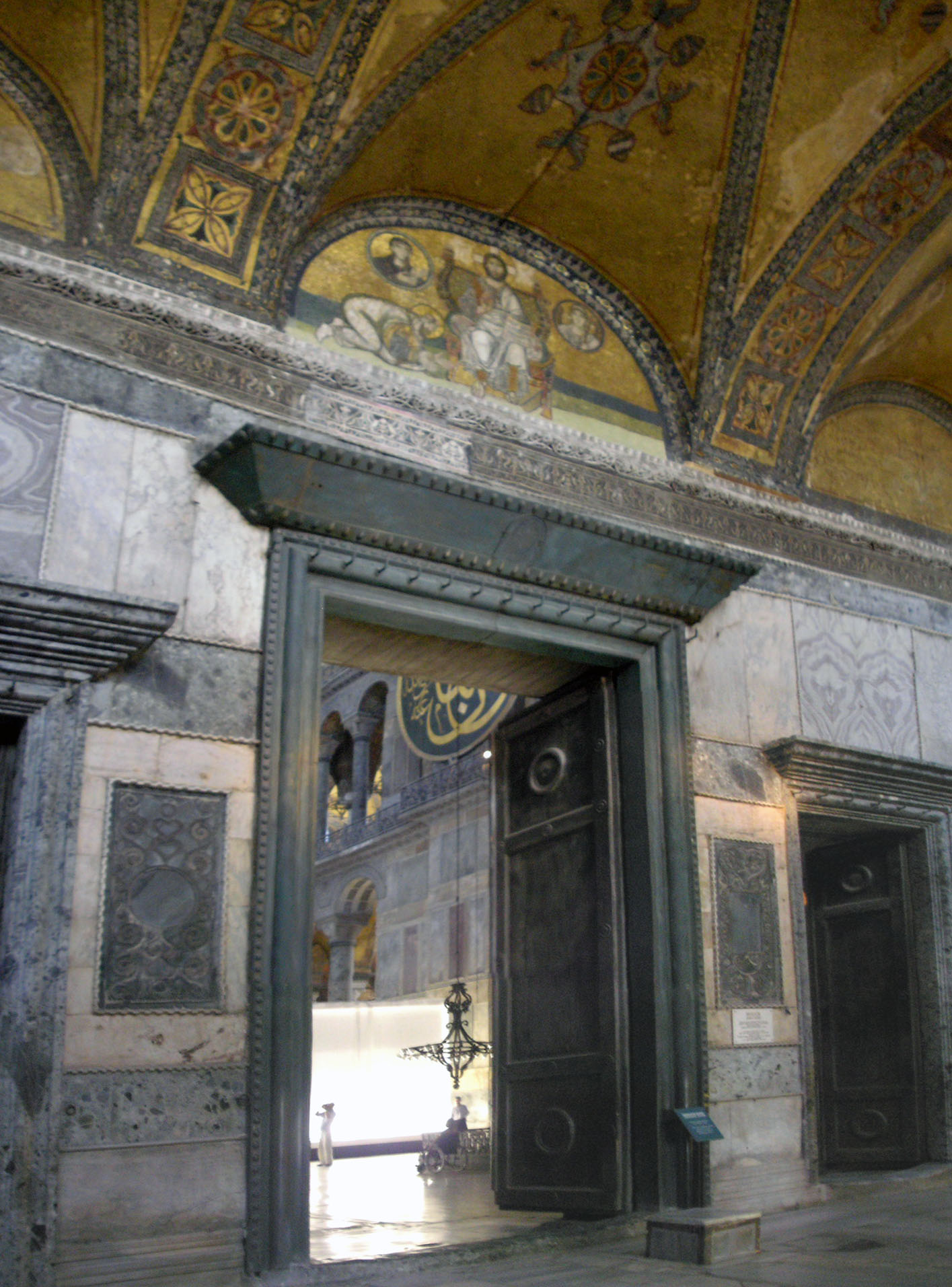
The Imperial Gate of the Hagia Sofia
showing 9th century mosaics over the door
All of this is a myth built up over time. In reality, the Dark Ages weren’t dark, the Middle Ages weren’t backwards and the Renaissance never happened (there were so many mini renaissances during the Middle Ages it's hard to tell when one ended and a new one began). You might as well forget everything you ever learned about the Middle Ages, because it probably isn’t true.
To start out, the Dark Ages weren’t dark.

When the Visigoths sacked Rome, the empire didn’t fall into a heap of ashes. It was re-allotted and
earliest known icon of Jesus
from Saint Catherine's Monastery
in the Sinai, c. 6th - 7th centuries
renamed, but Rome lived on in the East in the form of the Byzantine Empire. One need only to look at the beautiful architecture of the churches built in Constantinople to know that the Dark Ages were anything but dark. The HagiaSofia and the Hagia Irene are two churches that have remained standing through fifteen hundred years of earthquakes, fires and conquests. Recent restoration work has uncovered exquisite mosaics and paintings; gold leaf would have dazzled in the interior of these churches. They seem almost weightless and a little more than a hundred years after they were built, the architecture was copied in the Dome of the Rock.
Over in England, things weren’t going quite as well at first. When Rome removed her legions, England fell prey first to the Saxons, then the Vikings. The native Britons intermarried with the newcomers, or withdrew into the perimeters; into Wales, Scotland and Ireland. Here, missionary work was staged in an attempt to convert the invaders. It wasn’t unsuccessful.
Elaborate buckle from the Sutton Hoo burial
6th - 7th century
If you’d happened to walk near the wharfs in London, or Southampton during the Dark Ages, you would have seen a bustling seaport with merchant ships sailing as far afield as the Red Sea to bring back precious dyes, silks and spices. We know the Vikings traded with India and perhaps even China, bringing back statues of Buddha and silk. In fact, there’s Viking graffiti in the Hagia Sofia.
In this shoulder clasp from the Sutton Hoo burial
                each inlaid garnet was backed with carefully worked
gold foil to scatter the light, 6th - 7th century

The art from the Dark Ages is breath-taking. Pieces recovered from the Sutton Hoo burial mound
The filigree work on the Alfred Jewel
9th century
are so intricate they would have required four times magnification to create. Alfred the Great, one of England’s greatest kings was a world traveller (he went as far afield as Rome) and his court flocked with scholars. Admittedly, he learned to read and write in later adulthood, but he spent quite a bit of his time translating the Bible. He encouraged education and reformed the legal system and was really the first King of All England (that excludes Scotland, Wales and the Danelaw). He even started the Navy.
Things were going along splendidly during the Dark Ages, until, at the end of the 10th century and the beginning of the 11th, misplaced Vikings, named Normans, busied themselves in conquering much of France and Italy. One, named William the Conqueror, even dropped in on England. Things would never be the same again.
Anglo-Saxon claw beaker
6th - 7th centuries
When the Normans happened to Europe, learning took a major setback. Art and culture suddenly seemed on hold as Norman regimentation moved in with massive stone castles and suppression by annihilation. Anyone who could, built a castle and huddled down to weather the storm. But despite the battles and bloodshed, our old friend Enlightenment didn't stay long in the background. 
Stay tuned for how the Middle Ages weren't backwards...
~Psyche

Note: In nearly all my posts, I've included links to pages with more information on the subjects I've mentioned. I hope you have been finding these helpful. :)