|
| Jim Hawkins and Israel Hands from Treasure Island |
Mostly thanks to Treasure Island, when the word ‘pirate’
is spoken today, we instantly conjure up a picture of flintlock pistols, the
Caribbean, ostrich feathers, eye patches and the Jolly Roger. Amazingly enough,
pretty much everything we think we know about pirates sprang from that one book
published in 1883. Things like the black spot, one legged men with parrots,
treasure maps, ‘X’ marks the spot, and fifteen men on a dead man’s chest (how
can you get fifteen men on a dead man’s chest?) came from the spectacular
imagination of Robert Lewis Stevenson. A few details were filled in by other
people, of course, like Daniel Defoe, Washington Irving, Sir Walter Scott, J.M. Barrie and Howard Pyle.
Hollywood actors did their bit, too; Errol Flynn was swashbuckling and Robert Newton made the West Country accent of
southern England and Cornwall synonymous with pirates (eg: Arrg Matey!).
 |
| Julius Caesar |
Unsurprisingly,
pretty much all of this is myth and legend. Piracy never was (and still isn’t)
anything like the movies and is such a general crime that nobody can say “it
started here”. The Romans dealt with pirates in their day (Julius Caesar was
even held for ransom a couple of times)…no Jolly Rogers fluttered from their mastheads, but
merchant ships could still tell when one was coming by their characteristic
green or blue sails. The Vikings were pirates in every sense of the word; when
they weren’t moving in, they were taking loot and capturing European slaves to
sell into slavery in the Far East.
 |
| Burning of the USS Philadelphia |
The Barbary Pirates (or Ottoman corsairs) who operated out of Northern Africa, regularly raided Europe, as far north as England, Ireland and even Iceland, capturing whole
towns to sell into slavery in the Middle East. They weren’t checked for
hundreds of years until Thomas Jefferson sent the young United States Navy to
the Mediterranean to take them on.
Pretty much
anywhere there is a source of wealth, there are pirates. It’s highway robbery
without the highway. And as shown by the Vikings, or the Barbary Pirates, piracy
and slavery go hand-in-hand, even the Cilician pirates that pestered the Romans
traded slaves. John Hawkins, a 16th
century British Naval commander dabbled in piracy until he found a far more
lucrative option…the African slave trade. It was the African slave trade that
turned both sides of the Atlantic into pirate waters. Merchant captains picked
up slaves in Africa, then traded them for the valuable goods produced by the
New World like sugar and tobacco. Pirates of all nationalities preyed on them
in between…and sometimes piracy wasn’t entirely illegal. Navies were small, so
during wars, governments issued licenses called ‘letters-of-marque’ to ship
captains, allowing them to prey on the shipping of the enemy. This turned these
captains into ‘Privateers’, free-lance extensions of the navy.
 |
| Rose Hall Great House, Jamaica; houses like this one were built all over the Caribbean by plantation owners |
So, to boil it down, pirates didn’t make people walk
the plank (there are a few isolated
instances of it), they didn’t always believe women were bad luck aboard ship (women were actually considered better navigators than men), they didn’t wear eye patches
any more often than anyone else (there is some speculation they wore them to
improve their night vision). Pirates didn’t stay in one place, either, they made the rounds. The Mediterranean, the Red Sea, Indian Ocean and the China
Seas were stiff with the same pirates that sailed the Caribbean. Piracy was a
risky, dangerous business, completely lacking in glamour; pirates like Henry
Morgan and Edward Low were notorious for their deliberate cruelty. Only a
handful of professional pirates made a fortune, the rest spent it all, or died
of illness or execution (Henry Every
was one of the only pirates on record
who managed to escape and retire with his loot).
However…not everything we think of today in
association with pirates is myth.
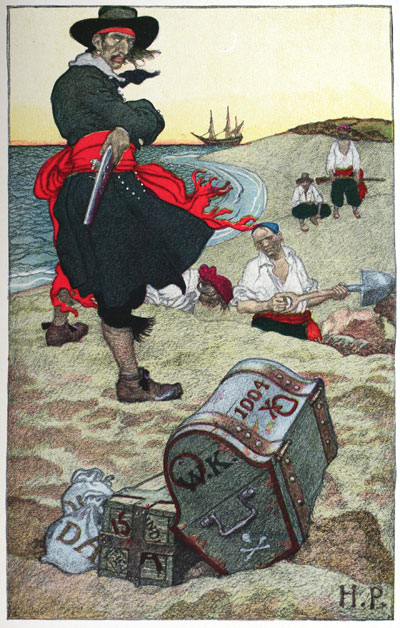 |
| Captain Kidd giving a dark look |
If you like flintlock pistols, skulls and
crossbones, pirate brotherhoods and sunken treasure, there is a period that
spanned the 17th and 18th centuries that might fulfill
your piracy dreams. It lasted about eighty years and is associated with the
‘famous’ pirates. Captain Kidd was hanging around Long Island during this time
and Henry Morgan, pirate turned pirate chaser, carved out a reputation so
infamous he was knighted and made governor of Jamaica. But within this period,
there was a smaller one; it only lasted ten years, but it is called ‘The Golden Age of Piracy’. Pretty much everything real
that we associate with pirates occurred during this time.
 |
| The Brig La Grace is a replica of the sort of ship pirates would have sailed; small, fast and relatively easy to handle |
It happened
just at the end of the War of Spanish Succession, or Queen Anne’s War as it was
referred to in the Americas. When the fighting ended in 1714, privateer
captains suddenly found themselves out of a job and when the Royal Governor of
Jamaica, Lord Archibald Hamilton, started handing out secret letters-of-marque to form a Jacobite Navy (yes, he was Scottish and yes, he hated the English),
things spun out of control. Big pirate names crawled out of the woodwork: Henry
Jennings, Charles Vane, Samuel Bellamy, and Edward England…and before long, Stede
Bonnet, “Calico” Jack Rackham, Anne Bonny and Mary Read, Bartholomew "Black
Bart” Roberts, Edward Low, William Fly, and most infamous of all, Edward
Teach…soon to be known as Blackbeard.
 |
| Port Royal, Jamaica, went from a pirate haven to a ghost town after an earthquake caused it to fall into the habor |
Since Henry Morgan, with the help of a cooperative earthquake, had cleaned up Jamaica at the end of the last century, these new
pirates set up shop in Nassau. The few hundred occupants of the town were
outnumbered by more than a thousand pirates and the whole island of New
Providence was declared a Pirate Republic. It was during this time that pirate
flags were occasionally flown…and most of the time, they had nothing to do with
a skull and crossbones…only "Black Sam" Bellamy and Edward England
flew the classic ‘Pirate Flag’, the other flags consisted of red skeletons and
crossed cutlasses. In fact, the only thing they had in common was the black
ground, which developed from the ‘Black Flag’ of no quarter every ship carried.
 |
| Calico Jack's Flag |
These pirates set to work on the rich shipping in
the Caribbean…there was the Spanish treasure fleet and ships of the Dutch,
Danish, French and Swedish West India companies. The records of ships captured in
the 18th century are suddenly littered with the names of pirates. But,
as mentioned before, the Golden Age of Piracy didn’t last long. A few, like
William Fly, held on until 1726, but most of the pirates, like “Black Sam”
Bellamy, Blackbeard and Calico Jack, only had two or three years of pirating
under their belts before the Royal Navy hunted them down between 1717 and 1720
(Blackbeard supposedly jumped overboard and swam around his ship three times after his head was chopped off).
Governor Woodes Rogers arrived in the Bahamas and offered pardons all around
and Governor Hamilton, the fellow who started it all, was brought back to
London in chains where he was acquitted…after all, his big brother was the Duke
of Hamilton. You don’t mess with a Duke.
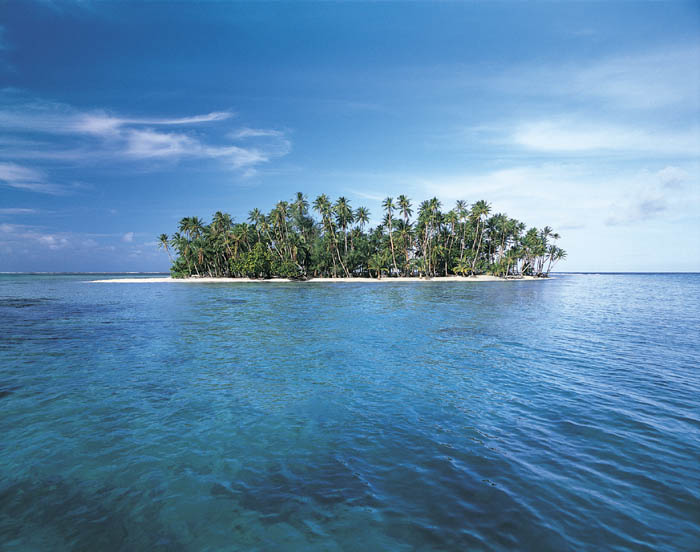 |
| A Desert Island |
But, despite being only about ten years long, that
period after Queen Anne’s War has had a massive impact on pirate lore.
Thousands of years of global piracy have paraded grandly past, yet we’re stuck
on flintlock pistols and islands in the Caribbean. We have ‘talk like a pirate day’ and romanticize about how ‘free’ pirates were. Gentleman pirates swing on convenient ropes like Tarzan while wooing the fair maid. In most of the
depictions, pirates are so busy adventuring that they hardly have time for
piracy at all.
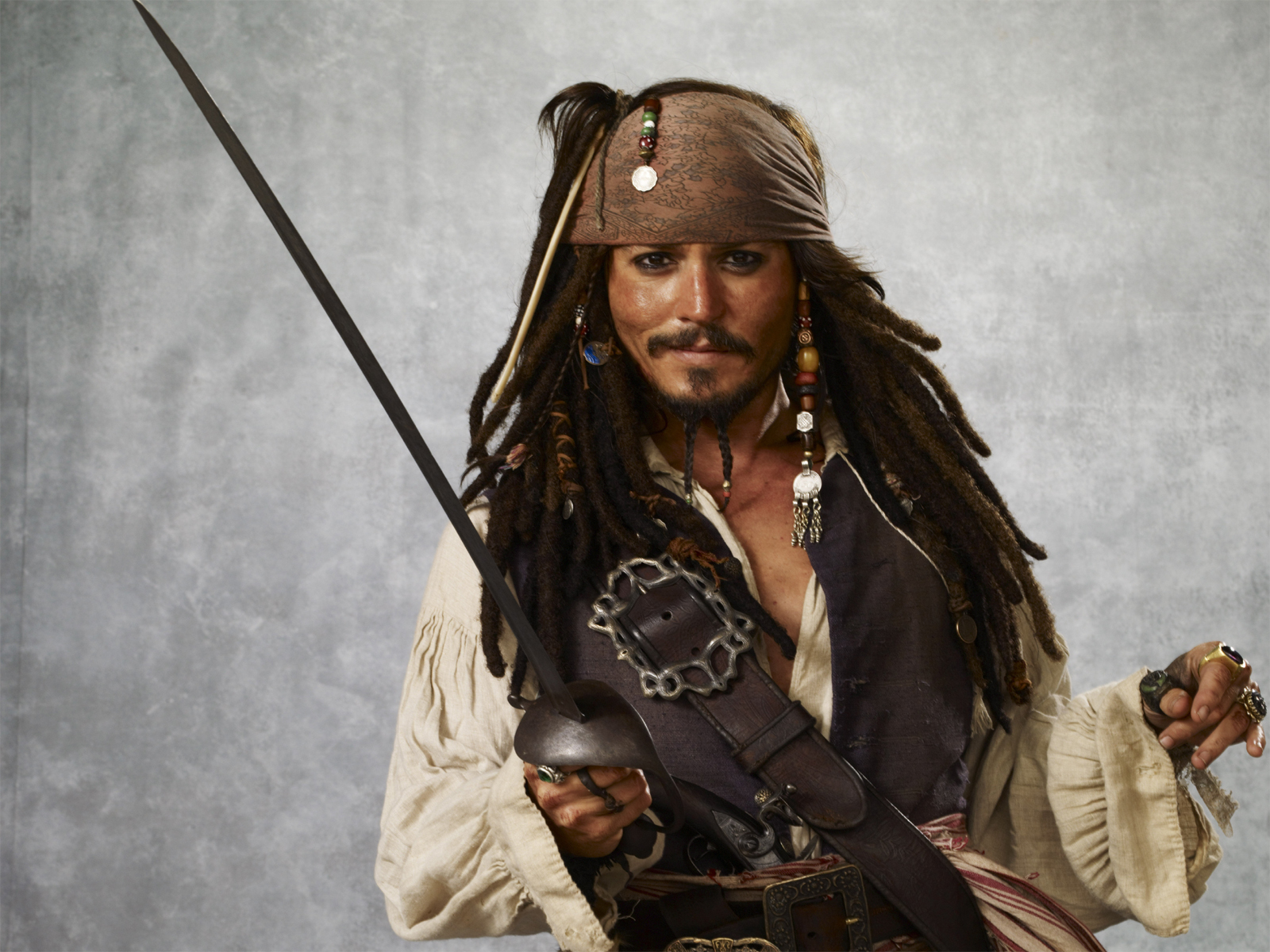 |
| As far as I know, pirates did not look like this |
The dirty, disease-ridden, brutal reality of
piracy is often overlooked for ostrich feathers and elegant coats. Piracy
hasn’t changed since the world began and it’s still practiced as much today as
it was during ‘The Golden Age’. The ships are made out of fiberglass now and
the perpetrators don’t have eye patches or cutlasses, but they are still
pirates, still capturing ships and holding them for ransom. As much as I want
to buckle some swash every time I watch The
Pirates of the Caribbean, it’s important to keep in mind that almost
nothing in the movies depicts reality.
If you’re interested in knowing more, a good place
to start is the book that opened my eyes,
Under the Black Flag by Erik Christian Haugaard. It’s short and it’s a children’s book…but those aren’t
marks against it.
~Psyche
PS: None of the pictures are mine