Saturday, September 20, 2014

E. Nesbit

The authoress, herself
I couldn’t help noting, after recently revisiting her books, how much influence Edith Nesbit had on later fantasy writers.
She was born in 1858 in Surrey, and, because her sister had poor health, saw a good bit of the world before she finally married a rake (she didn’t know he was a rake until after she married him, but she remained married to him, despite discovering and adopting several children of his that did not belong to her). She was a great friend and fellow Fabian of author William Morris (who deeply influenced J.R.R. Tolkien with his various writings, especially The Well at the World’s End). Edith, herself, wrote various poems and books for adults, but it wasn’t until the publication of The Treasure Seekers in 1898, that she became really beloved.
And she’s still beloved. I believe her most famous book is The Five Children and It, where five children (you guessed it) meet ‘It’, which happens to be a Psammead (which is pronounced ‘Sammy-ad’). I won’t describe It, because everybody knows what a Psammead is (and if you don’t, you should). Read the book. Don’t watch the recent movie. It isn’t worth it.
A still from the movie....looks familiar, doesn't it?
Edith Nesbit captured the wide-eyed innocence of childhood; despite her political leanings, she manages to paint an unspoiled and beautiful world where children always have tea on time and things always work out just as they should (which is not parallel to her own unhappy life).
In my opinion, her strength was her uncanny skill with fantasy. Her imagination was nearly boundless…there’s nothing formulaic about her work. Sometimes her characters build cities on the nursery floor which come to life, other times, they meet unlikely friends like a phoenix and a magic carpet (which behave in a curiously ordinary and believable way).
And she always had twists and turns which are completely hilarious and utterly unpredictable…like wishing for milk to feed nine hundred cats (don’t ask where they came from) and getting a whole cow (which I probably needn’t tell you is inconvenient in a nursery).
George MacDonald - a rather shaggy, but very interesting
character, who I might talk about some other time
I think she, along with George MacDonald, laid the foundations of modern fantasy. C. S. Lewis was especially inspired by her. Her light-hearted style must have resonated with him, because his is similar. His Grecian, psudo-medieval world of Narnia could almost have stepped out of one of her books…and some other things really did, like statues that come alive, children that find a magic, seemingly abandoned castle in the woods, or a little girl named Lucy who steps through a door into a magical world.

I’m not trying to say C. S. Lewis stole her ideas, or that his books are inferior (anyone who knows me knows that isn’t true)…but I am trying to say that Edith Nesbit isn’t as well-known as she should be. If you haven’t, you should read her books. They can be found for free everywhere from Amazon to Project Gutenberg, and if you’d rather not have a digital edition, go to a used book store. You’ll probably find them tucked away somewhere in a corner, waiting for you to come along. As Oswald Bastable would say, “They’re absolutely A1!”   

~Psyche

Monday, September 15, 2014

Civil Disobedience

“I have lived some thirty years on this planet, and I have yet to hear the first syllable of valuable or even earnest advice from my seniors.” ~Henry Thoreau from Civil Disobedience
*
Henry David Thoreau died in 1862, forty-four years after he was born. He was remarkably ugly in appearance, as noted by Nathanial Hawthorne, “[Thoreau] is as ugly as sin, long-nosed, queer-mouthed, and with uncouth and rustic, though courteous manners, corresponding very well with such an exterior. But his ugliness is of an honest and agreeable fashion, and becomes him much better than beauty.”

Thoreau
Thoreau was peculiar from birth, and when he met Ralph Waldo Emerson, he became an avid student of his doctrine of self-deity and oneness with nature. Each thought that no one else in the world appreciated nature as much as he did, and Thoreau had little use for anything outside of the great outdoors. Of newspapers he said, “If we read of one man robbed, or murdered, or killed by accident…we never need read of another…if you are acquainted with the principle, what do you care for a myriad instances and applications?

Thoreau must have taken Emerson’s Self-Reliance to heart. Thoreau built himself a hut on Emerson’s property by squatters rights – a hut so small, a friend called it a ‘sentry box’– and lived there for two years, growing his own food and wandering the woods for more than half the day. He wrote Walden, telling of his experiences and outlining his success in using a very small amount of money during the time he lived there. He forgot to add that he didn’t have to pay taxes on the land, because of squatter’s rights…not to mention his poll tax.

During the time Thoreau was living in his hut and communing with nature, he went to town to pick up his shoe at the cobbler’s. He was confronted by the town sheriff, Sam Staples, who asked him why he hadn’t paid his poll tax for six years and added that he would pay it himself if Thoreau didn’t have the money. Thoreau did have the money, he just wasn’t paying it. He was against the Mexican War he explained and the Sheriff unhappily locked him up. The next morning he was released; somebody had paid the tax. Thoreau had made his protest against the war, so he got his shoe and went home to his sentry box.

As was his way, Thoreau later wrote up his jail experiences into a book entitled Civil Disobedience.
Emerson
He started it with the line, “I heartily accept the motto, ‘that government is best which governs least,” but added that he really believed, “that government is best which governs not at all.” He explained that he had no respect for the state, but rather pitied it. Since, as a transcendentalist he believed that he was divine, he thought it strange that the state could lock him up as mere flesh and blood. “I saw that, if there was a wall of stone between me and my townsmen, there was a still more difficult one to climb or break through before they could get to be as free as I was…They plainly did not know how to treat me, but behaved like persons who are underbred.” 

In Walden Thoreau wrote, “The greater part of what my neighbors call good I believe in my soul to be bad, and if I repent of anything, it is very likely to be my good behavior.”  His view of right and wrong clearly mirrors Emerson’s in Self¬-Reliance when he said, “No law can be sacred to me but that of my nature. Good and bad are but names very readily transferable to that or this; the only right is what is after my constitution; the only wrong what is against it.

Transcendentalism, Emerson’s doctrine, was a belief of self-deity; a dismissal of any higher Being or Law. It taught that anything goes and 'good' and 'evil' simply don't exist. Both Emerson and Thoreau failed to realize that without values, the world would be run by everyone's personal whims, which would result in chaos. In Civil Disobedience, Thoreau said of the government, “It does not keep the country free. It does not settle the West. It does not educate. The character inherent in the American people has done all that has been accomplished…” in some ways, this is correct, but Thoreau did not realize that the 'inherent character' of the American people and his own ‘good behavior’ were not inherit at all, but were the remnants of the biblical values of his ancestors.


Sunday, August 24, 2014

Super...Heroes?

There's only one God, ma'am. And I'm pretty sure he doesn't dress like that.
~ Captain America, The Avengers

I’ve always had a faint distrust of superheroes that has gradually increased over the years. In today’s era of increasingly better computer rendering, pretty much nothing is impossible. People fly through the air, buildings blow up, cities are levelled.
Superheroes seem to be in the business of regularly saving the world. Most of them grow up kissed by the gods and discover at some point that they have superhuman qualities; the rest are transformed into superheroes by doctors who dabble in science fiction.
Superman
(In case you couldn't guess)
Superheroes are too easy. Cities face destruction as evil villains rise up over cowering and innocent civilians. The superhero arrives just in time to save the world. Every time.
The thing most superhero stories and books overlook is that villains are created by the innocent people. Every arch enemy in history (Hitler, Stalin, Mussolini, Mau, Napoleon...etc…) would have been powerless without the support of his people. The people created their own destruction. Yes, they were deceived, but they still facilitated it even when all the sign posts pointed to their folly, and afterwards, they wanted the superhero to bail them out with as little inconvenience to them as possible. It’s human nature, after all.
A tiny wayside flower...the Scarlet Pimpernel
Because of this quality of mankind, superheroes go way back. We’re all familiar with the greats like Superman, Batman, Spiderman and the rest, but few know the origin of these super people. One of the first to grace us with his presence was the Scarlet Pimpernel, an English chapo who played dumb in public, but, in his spare time, saved innocents from under the blade of the Guillotine during the French Revolution. Baroness Orczy, his creator, started writing after she thought she could do better than the authors of the dime novels popular in the late 1800s.
My favorite Zorro- Guy Williams
Sir Percy, The Scarlet Pimpernel, touched off a snowball of heroism. Real people, inspired by his fictional heroism, braved death to save lives. Pimpernel Smith was a modern day (as of 1941) adaption of the Scarlet Pimpernel, that inspired Swedish diplomat, Raoul Wallenberg, to do some rescuing. He’s credited with saving more than 15,000 Jews. And he wasn’t the only one stimulated by Baroness Orcsy’s superhero.
The Scarlet Pimpernel also inspired another story about a “hero with a secret identity”. Zorro, the fox, was the first Dark Knight. Dressed completely in black and wearing a mask, Don Diego De La Vaga, rode out into the night to save people from the evil Spanish in 19th century California.
Errol Flynn
But we can go back a lot further than The Scarlet Pimpernel and The Curse of Capistrano to find the origin of the superhero. In fact, Achilles, the greatest Greek during the Trojan War, has all the accruements of a modern day superhero. He has superhuman strength, practical immortality, special armour, skills, and a custom made superhero chariot with two super horses. He even has an Achilles’ heel (no pun intended), like many superheroes. The only thing he lacks is the perceived goodness of today’s superheroes.
That’s the thing with superheroes. They aren’t real heroes. Many attempts now-a-days have been made to humanize them, but they all seem to be born with more than their fair share of bravery. They’re a bit like Scotland Yard detectives, Navy Seals and Errol Flynn, all rolled into the same package. Real heroes don’t have superhuman strength, good looks or unusual bravery. They’re people, just like you and me. They weren’t born to be great, they made it there on their own, and if you asked them about it, there’s a good chance they’d say they weren’t anything special.
Cincinnatus reporting for duty
Cincinnatus is a hero Rose and I are particularly fond of. To put it in a nutshell, he was working on his farm one day when an invasion happened. Cincinnatus dropped everything to save Rome, and later agreed to become dictator, but he resigned the office as soon as everything had been ironed out. Duration of his dictatorship? Two weeks.
Cincinnatus cannot be mentioned without a nod to George Washington, the United States’ own personal hero. George was a farmer at heart, but he left Mont Vernon behind to take command of the army. After he trounced the British, he presided over the drafting of the Constitution, then took the reins for two terms as president. This was all fine and dandy, but his true heroism (in my humble opinion) is not what he did, but what he didn’t do. The states eagerly offered to make him King George, but he flatly declined. We came that close to having a dynasty of Washingtons in the White House.

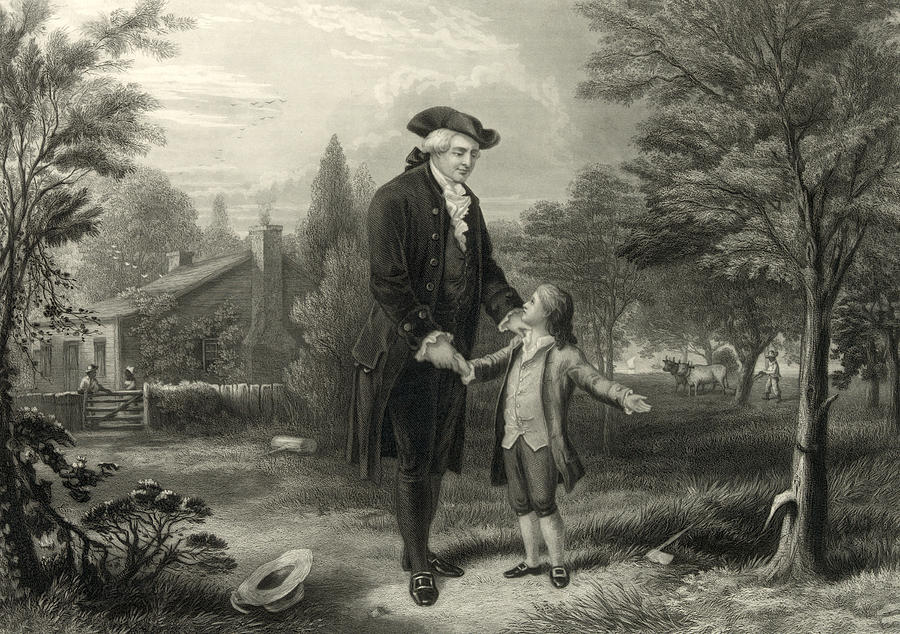
Couldn't tell a lie...but he could chop down the cherry tree
In the end, heroes, real heroes, are often overlooked and forgotten, mostly because they made light of what they did. They rarely are reworded and often aren’t lauded in their lifetimes (and sometimes are forgotten afterwards). They didn’t come with powers any greater than yours or mine…in fact often times the powers they did come with (tempers, strength…) had to be curbed before they could do anything useful.
The truth is, a superhero isn’t going to come sweeping in to fix your bumbled mess for you. Probably if you saw a weirdo wearing red, yellow and blue (with his underwear on the outside), you’d most likely call the police. I know I would.
Superheroes are super, but they ain’t heroes. Heroism is about giving up everything, not gaining powers. Heroism is about humility, not fancy suits. Heroism is about being completely terrified, but doing it anyway. Two thousand years ago, my superhero gave up everything, was whipped, tortured and finally left to die, nailed by his hands and feet to a wooden beam.

I don’t think even Superman could have done that. 
~Psyche