Monday, March 9, 2015

Heartfelt Apologies

I've done the unthinkable. The unspeakable. The unfathomable. But hopefully not the unforgivable.

I missed a blog post.

I was going to give you a decadent piece about the evolution of pens from 1850 to 1950, but, due to circumstances beyond my control, I can't. The truth is, in this modern age of technology and civilization, most people don't have high speed internet. 81% of Americans use the internet, but in many states only half the population have any internet at all. I live in one of the most interneted states in the country...but I think this is a myth spread about by the general populace, because it happens to be my state's only claim to fame. Presently, I'm in the percentage of people who are paying for internet, but aren't getting anything for their money. Or precious little, anyway.

I'll post this, but I can't upload any pictures or do any surfing of the web. In short, I am forced to bore you to death with picture-less ramblings.

In conclusion, I am going to present you with a peace offering in the form of a completely unrelated poem which I wrote this past summer after a face-to-face encounter with a garter snake. Hopefully it won't leave you gnashing your teeth.

A Rhyme Concerning a Snake


I saw a little snake today
While walking across the grass
He looked at me with curiosity
Then trickled away at last

With shining jewel-like eyes, and scales
Like shadow-patterns in the grass,
He watched me, and I watched him
As if on either side of glass

We studied each other like at a zoo
Only, whether it was me, or him
Or both of us, behind the glass
I don’t really think we knew.

Sunday, February 15, 2015

Evelina: Or the History of a Young Lady's Entrance into the World

Frances Burney by her cousin, Edward Francis Burney
Most people know who Jane Austen was. A mention of her most famous book, Pride and Prejudice, will probably conjure up the vivacious and lively Elizabeth Bennet, and the rich and enigmatic Mr Darcy. Miss Austen’s books, and life, have been made into so many movies that, chances are, you’ll know what all her most famous books were about without even having read them.  
However, unless you are an 18th century literature enthusiast, you probably don’t know who Frances Burney was. The name ‘Evelina Anville’, won’t ring a bell; neither will ‘Lord Orville’…but I think it’s safe to say, that without them, the world would never have been introduced to Elizabeth and Mr Darcy. It’s not even going too far to mention their influence on Charles Dickens.
A facsimile edition of Evelina from 1903
Evelina had a rather tumultuous beginning. Its author, Frances Burney, was the daughter of Charles Burney, who knew everyone there was to know in the higher circles of life. Frances had met Doctor Johnson of the Dictionary, and, in relation to my last post, WilliamBligh, who had sailed with her older brother alongside Captain Cook. She was self-taught, literally. She read books compulsively, teaching herself grammar and spelling; by the time she was ten, she was writing to keep herself company. Her first attempt at a novel was The History of Caroline Evelyn, which she burned in its entirety when she was fifteen. Evelina, in many ways is the daughter of the lost manuscript; Frances Burney was trying again, and the title character, Evelina, was the daughter of the unfortunate Caroline.
Robinson Crusoe as imagined by N. C. Wyeth
A hundred years of English novels proceeded it. In the late 17th century, novels were thought of as shocking and crude; not fit for the better classes of people. Novels were considered improper, and indeed, many of them were, but ever since Daniel Defoe had fictionalized and romanticized Alexander Selkirk’s four-year,self-imposed sojourn on a desert island in the form of Robinson Crusoe in 1719, novels had taken England by storm. No longer was reading for instruction; analogies like Pilgrim’s Progress, from 1678, which taught as well as entertained, were giving way to reading material that was meant for pure enjoyment. 
When Frances Burney was busy writing at the end of the 18th century, there was still a clash between lurid, graphic reading material like Tom Jones of 1749, or the later (and disturbing) gothic novel, The Monk of 1796 (satirized in Northanger Abbey), and proper novels, like the books of manners that Jane Austen would eventually pen. It was a risky business publishing a book, but Frances Burney persevered; in 1778, her older brother managed to publish Evelina for her under a pseudonym to public and critical acclaim.  Edmund Burke and Samuel Johnson praised it highly; little did they know it was written by a shy, young women of only twenty-six whom they both knew.
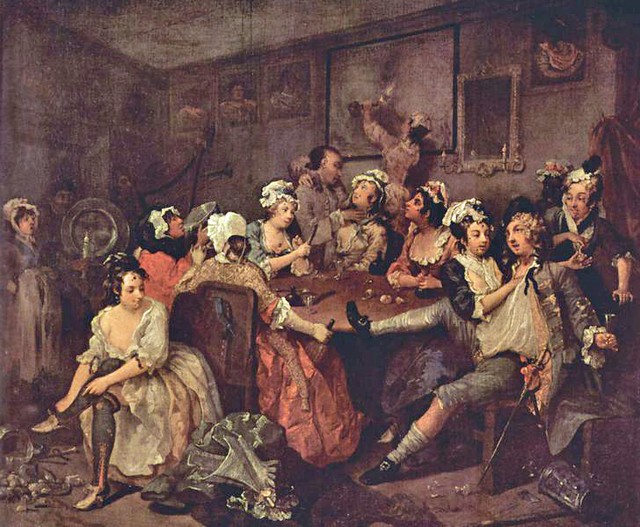
A plate from A Rake's Progress by William Hogarth, showing
the 18th century for what it was: almost completely lacking in 
the decorum and modesty that would become hallmarks of the 
Victorian era
Evelina is written in the form of letters, exchanged between a seventeen-year-old girl on her first venture into the great world, to her guardian, Reverend Villiers of Berry Hill. This was not an uncommon way of writing novels in those days; Jane Austen wrote her first novel, Love and Friendship, in the form of letters between 1783 and 1790. One of the first epistolary novels was Love-Letters Between a Nobleman and His Sister (yes, it’s every bit as bad as it sounds) written by Aphra Behn in the 1680s. Evelina bears some minor resemblances to this, and other earlier novels, like those by Samuel Richardson, but is, in many ways, a very new and different sort of book than had ever been written before. 
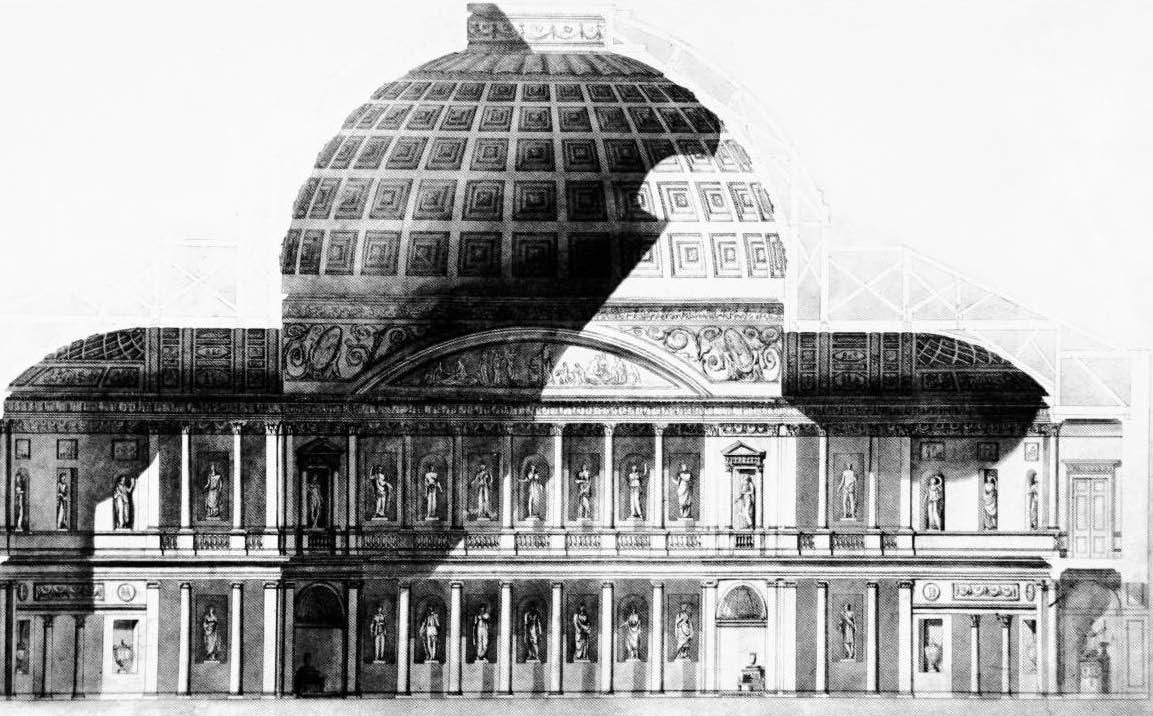
The Pantheon in London, modeled after its namesake in Rome,
was once one of the grandest assembly rooms in England
The most important aspect of Evelina, is its incredible realism. Unfortunately considered long-winded and cumbersome by today’s standards, Evelina was revolutionary in its day. Over a period of seven months, the letters meticulously describe aworld that is completely alien to us today. Though the eyes of the heroine, we see London, hot, dirty…but terribly exciting. There are balls to visit, gardens, Cox’s Museum, which was an array of elaborate mechanical devices. Evelina writes, “They tell me that London is now in full splendour. Two playhouses are open, – the Opera-house, – Ranelagh, – and the Pantheon. – You see I have learned all their names.” When she goes to visit them, we find out first-hand, what it’s like to sit in an 18th century box and watch an 18th century opera. 
Ranelagh Gardens in Chelsea were at their height when
public gardens were all the rage
And of course, no period romance would be complete without balls, and Evelina goes to her share of them and has her share of misunderstandings when she accidentally breaks the social codes; "[she is] A poor weak girl!” Lord Orville remarks when asked his first impression of her ('weak' in this instance meaning 'weak-minded'). In this way, at least, Evelina isn’t quite accessible to the modern reader. Frances Burney was writing for her time; she didn’t realize that two hundred years after the fact, people would still be reading her book. Word usage has changed and there are many other things taken for granted that her readers would have known, such as realizing the full import (or the impossibility) of an Earl proposing marriage to seemingly penniless (and possibly illegitimate) young girl; this doesn’t detract from the story…it’s all the more interesting for learning about how different it was to live then.
The Colonnade at Hotwells, Bristol in 1788
by the Swiss artist Samuel Hieronymus Grimm
one of the locations for Evelina
On the other hand, Evelina is a very modern book. We still feel the emotions they felt then and are delighted by the same things. Not only are the circumstances surprisingly easy to relate to, but the language is modern. Contractions are scattered liberally through the dialog and Miss Burney’s ease at writing dialect marks her as a fore-runner of Charles Dickens. Many expressions which we still use today are scattered throughout Evelina, such as ‘in a huff’, ‘sick of it’, ‘the man in the moon’, ‘putting in one's oar’, ‘point-blank’, ‘changing with the tide’ and ‘thing-em-bob’. Even some of our prejudices can be dispelled; women might not have had the vote in 1778, but they had a voice. Mrs. Selwyn, an independent woman with a large fortune, regularly runs rings around the men with her wit and intelligence. As Mrs. Selwyn says, “Come, gentlemen…why do you hesitate? I am sure you cannot be afraid of a weak woman?”
We all know Shakespeare had wit, but so did Fanny Burney. I don’t think any of Jane Austen’s books are as laughter-inducing as Evelina. Partly because she was so young and partly because she had a natural turn for humor, Frances Burney often turned serious moments into comedy. There’s a pre-planned hold-up and mugging of Evelina’s pretend-French grandmother by pretend-highway bandits and Sir Clement Willoughby, Burney’s hilarious and good-natured villain, is always ready to be amusing. Even the near-perfect hero, Lord Orville, on closer inspection, becomes a flawed, but humorous and kind-hearted character.
Frances Burney went on to write other books, but the spontaneity and light-heartedness of Evelina set it apart. Yes, it deeply influenced Jane Austen and her much more famous books, but Evelina can stand very well on its own two feet. It marked a turning of the tide, the opening of the door to a genre that we still can’t get enough of. It is tragic, then, that Evelina, and its author, are not better known. They deserve to be.


Excerpt from Evelina:
THERE is to be no end to the troubles of last night. I have this moment, between persuasion and laughter, gathered from Maria the most curious dialogue that ever I heard. You will at first be startled at my vanity; but, my dear Sir, have patience!
It must have passed while I was sitting with Mrs. Mirvan, in the card-room. Maria was taking some refreshment, and saw Lord Orville advancing for the same purpose himself; but he did not know her, though she immediately recollected him. Presently after, a very gay-looking man, stepping hastily up to him cried, "Why, my Lord, what have you done with your lovely partner?"
"Nothing!” answered Lord Orville with a smile and a shrug.
"By Jove," cried the man, "she is the most beautiful creature I ever saw in my life!"
Lord Orville, as he well might, laughed; but answered, "Yes, a pretty modest-looking girl."
"O my Lord!" cried the madman, "she is an angel!"
“A silent one," returned he.
"Why ay, my Lord, how stands she as to that? She looks all intelligence and expression."
"A poor weak girl!" answered Lord Orville, shaking his head.

I don’t know about you, but there’s something about this excerpt that reminds me of a discussion between Mr Bingly and Mr Darcy about Elizabeth Bennet in Pride and Prejudice, and Mr Darcy’s comment, “[She is] not handsome enough to tempt me.”

Thursday, January 29, 2015

Captain Bligh: Chronically Misrepresented

Bligh, as he appeared in 1792,
Not exactly looking like a homicidal maniac
In the late 18th century, a plan was hatched to introduce breadfruit trees from the Polynesian Islands to the Caribbean to feed the growing population, both slave and free, that worked the vast sugar plantations. Today, breadfruit flourishes in the Caribbean largely due to one man, then a thirty-three year old lieutenant in the Royal Navy known as William Bligh.
Almost everyone knows about the Mutiny on the Bounty. Whenever ‘mutiny’ is mentioned, ‘Bounty’ is slapped on, too. The story is now used as a symbol of rebellion against oppression, a poster child of Navy brutality, a struggle between the aristocracy and the common man. In many ways, it’s true; there was a rebellion, life at sea was brutal, and it was a struggle between the aristocracy and the common man…though not in the way that you are thinking, because William Bligh was the common man and Fletcher Christian was the aristocracy.
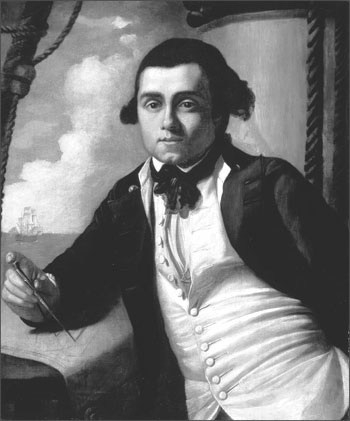
Bligh at twenty-one, as Cook's Sailing Master
William Bligh was in the Navy since he was seven. He served as an able-seaman, when there were no vacancies for a midshipman, slowly working his way through the ranks. Because of his brilliance in navigation, at the age of twenty-one, he served as Captain James Cook’s Sailing Master in his last voyage of discovery in the South Seas. It is from Bligh that we have one of the most complete accounts of the death of Captain Cook in Hawaii; Bligh was nearly killed himself, but instead of allowing his men to scatter like the marines assigned to guard Captain Cook, he held his ground until reinforcements came from the ship.
Breadfruit
William Bligh seemed the ideal man to lead an expedition to collect breadfruit. He knew the area, he was a gifted navigator and cartographer, and was something of an explorer and naturalist as well. So, on 23 December, 1787, the young lieutenant set out, in command of a tiny ship named the Bounty, forty-six officers and men, and a friend of the family, Fletcher Christian, as Master’s Mate.
Thursday October Christian,
Fletcher Christian's oldest son
Fletcher Christian is something of an enigma. He was descended on his father’s side from Manx aristocracy. His was born on the pleasant Moorland Close estate and despite his mother’s irresponsibility with money, his upbringing would have been far superior to anything Bligh experienced as a child. Early in the 1780s, Bligh, ten years older, met Fletcher Christian, and took him on two voyages, meticulously teaching him navigation. It was on Bligh’s recommendation that Christian sailed as Master’s Mate on the Bounty.
The most accurate replica of the Bounty, from the 1984 movie,
currently resides in Hong Kong. The other replica, like its namesake,
is at the bottom of the sea.
Bligh has often been described as a sadistic commander, ruling with an iron fist and meting out terrible punishments right and left. He is universally depicted in movies by little men, ten or twenty years too old, with slightly neurotic performances, in command of replica ships twice as big as the real one. In reality, Bligh hardly ever punished his men, even allowing them to sleep during the hectic attempted rounding of the Horn in the only dry place aboard the ship: his tiny, closet-like sleeping cabin in the stern. The Bounty was a little ship, less than ninety feet long, and in a time when the average seaman stood at 5’4”, Bligh was a respectable 5’8”. Fletcher Christian was an inch taller, probably due to his better nutrition as a child.
Black sand in Tahiti
All in all, the Bounty had an uneventful voyage to the South Seas; one man died of an infection after he was bled by the drunk doctor, but otherwise, morale was good. On their navy-ordered route, storms lashed them during their attempt to double the Horn, but Bligh turned back, knowing that he was beaten, and sailed around the Cape of Good Hope instead. He managed not to lose a man in the storms when other ships, sailing the same waters that year, lost half their compliment.
The local wildlife
On the 26 October, 1788 the Bounty let down her anchor off the beautiful black sand beaches of Tahiti. For the next five months, with the help of the native chief and his people, the English sailors transplanted breadfruit trees into pots and put them in specially built containers in the great cabin of the Bounty. Bligh, when not overseeing the undertakings, was talking to the chief about his customs, surveying the harbor, and, because he was an artist, taking note of the local wildlife. Despite all his work, he noticed that his crew was getting on famously with the locals and by the time the Bounty set sail for England, a number of them were breaking out with venereal disease.
Maori Chief from New Zealand,
colored engraving 1784, copied from a painting
Bligh had a notorious temper and took most of his frustration out on Fletcher Christian, who seemed to be crossing him at every turn. Bligh’s sailors were busy getting tattoos and deserting, rather than potting breadfruit trees, and Bligh flogged them more on land than he had at sea. The native chief wasn’t helping any, either; Bligh reported that, “The chiefs have taken such a liking to our people that they have rather encouraged their stay among them than otherwise, and even made promises of large possessions.”
Captain Bligh & Co being set adrift
by the Mutinous Mister Christian
Everyone is probably familiar how, a few weeks into the return voyage, Bligh woke up to a dancing lantern over his head and a bayonet at his throat. He was taken on deck, and as the sun slowly rose, he and eighteen of his loyal crewmen were herded into the ship’s longboat and set adrift, to watch the Bounty sail off into the sunrise. For many, this is the end of the story; Fletcher Christian sailed off, first to Tahiti, to pick up wives and drop off sixteen of the mutineers, then to Pitcairn Island, with the remaining eight mutineers and many Tahitian men and women. Fletcher Christian’s ultimate fate is unknown, except that by 1808, only one mutineer was left alive; the rest had either murdered each other, or died of disease.
Captain Bligh's coconut, carved with the words,
"the cup I eat my miserable allowance out of"
For Bligh, the story had only begun. He was in a badly over-loaded open boat, with eighteen of his crew, limited food supplies, no maps and only an outdated quadrant and a pocket compass, 3,618 miles from civilization. The journey that followed is one of the most remarkable and little known in history; they withstood storms, hunger and cannibalistic islanders. Bligh, instead of being petty, was meticulously fair with the rations, often giving more to the sicker members of the crew to keep them alive. Bligh, himself, often went without sleep and most amazingly of all, was able to navigate accurately all the way to the coast of Australia with faulty and make-shift instruments and nothing but the maps in his head. On top of that, despite his emaciated condition, Bligh continued to draw maps of the coast, even discovering islands that had never before been seen by Europeans.
An artist's (optimistic) idea of what Bligh
and his crew looked like when they arrived in Timor
Forty-seven days after the mutiny, Bligh and his starving crew stumbled into Kupang, Timor. The first thing he did was write to his wife in heart-broken words, “Know then my own Dear Betsy, that I have lost the Bounty...” However, he had reason to be glad; despite the horrific conditions during the open-boat voyage, he had only lost one man who had disobeyed orders and was stoned to death by cannibals on Tofua.
Peter Heywood as a Post-Captain
Bligh returned to England a hero. It wasn’t until the fateful voyage of the HMS Pandora and the collection of the sixteen mutineers from Tahiti, that his name was blackened. One of the mutineers brought back for trial was a young midshipman named Peter Heywood, who, like Fletcher Christian, had family ties in Manx nobility. The Heywood family, uninterested in being related to a mutineer, managed to turn the story around during the trial to get Peter Haywood acquitted. But it wasn’t until the Bounty trilogy of the 1930s, and the subsequent movies based on them, that the story became so infamous.
A still from the 1935 Mutiny on the Bounty
Was Bligh to blame for the mutiny? Had life under him become so terrible that the crew had to mutiny? Bligh was known to be thin-skinned and self-righteous, but he was also forward-thinking; always concerned about his men’s health and welfare. Instead of being a brutal maniac, as depicted in popular culture, Bligh’s weakness seems to have been his lenient approach to discipline. Bligh went on to command other ships and other men, playing a key role in winning the Battle of Copenhagen, and even becoming governor of New South Wales, before retiring as Vice-Admiral of the Blue. He suffered two more mutinies under his command; one, which was fleet wide, and the other, in Australia, when he tried to root out corruption.

Tahiti Revisited by William Hodges 1776 
The voyage of the Bounty might have been a disaster, but Bligh had a second chance to do it right. In 1791, a year after returning to England, Bligh, in command of HMS Providence and accompanied by the smaller HMS Assistant, returned to Tahiti, collected his breadfruit and successfully introduced the species to the Caribbean.

~Psyche 

PS: In 2010, four men recreated Bligh’s amazing open boat voyage across the pacific with limited instruments and finished only one day over schedule. For a scholarly look at the events surrounding the mutiny, read The Bounty by Caroline Alexander.